How to Brew Your Own Beer and Mead


Table of Contents


Quick Reference — Specific Gravity and Densities

I have seen two formulas for calculating percentage alcohol by volume based on the change in specific gravity (Δ s.g.). The first is from the standard reference "The Complete Joy of Homebrewing":

%ethanol = 127*(Δ s.g.)

The other is from the Cooper's brewing supply company:

%ethanol = 0.5 + 134.05*(Δ s.g.)

The second of those seems to produce more realistic numbers.

Another handy number, the density of dextrose is 0.62 grams/cm3.
From http://www.powderandbulk.com/resources/bulk_density/material_bulk_density_chart_s.htm


Mead Background

Language Spelled Pronounced
East Slavic Russian мёд myod
Ukrainian мед myed
West Slavic Czech med med
Polish miód myod
South Slavic Bulgarian мед myed
Croat med med
Macedonian мед med
Serbian мед med

Long ago a people known as the Varangians lived around the Baltic Sea. Some of them moved south-east into today's Ukraine, and others moved west into Scandinavia. By about 800-1000 AD the two groups had become known as the Rus and the Vikings. They developed a class of fermented beverages generally known as mead. It was also discovered by the ancient Egyptians, Arabs, Greeks, Indians, and probably anyone else whose stored honey went bad in a good way. Notice that many Slavic languages use a word similar to mead to refer to honey.

This reminds me of when I worked in a hospital in Sankt-Peterburg, and in the summer you would see the local walking around in the evenings drinking from two-liter bottles of мёд. Well, sometimes staggering more than walking.

In the outer districts of Sankt-Peterburg, in the "sleeping regions" of large concrete apartment blocks, myod dealers operate out of kiosks along the broad streets in the summer. Sankt-Peterburg is about 60° north latitude and so it doesn't get fully dark at night during the summer. It's the "White Nights". hey, let's stay up and get even more drunk!

Also see Michael Crichton's "Eaters of the Dead", a great book. I read it and really liked it, but I couldn't figure out how much of it I was really supposed to believe. What about all those detailed footnotes referencing obscure documents in the Leningrad (at the time, earlier and later Sankt-Peterburg) and Baghdad archives? And what about that Ibn Fadlan guy? I wrote a letter to the publisher, and they forwarded it to the author, eventually resulting in a personal letter from Crichton.

He explained that he had written it in 1976 almost on a bet with a friend over Crichton's claim that "Beowulf" could be made into a popular story. Ibn Fadlan existed, and his journey north to the land of the Rus' as described in the first few chapters really happened as described in the book. I agree with Crichton, but I think that the movie Alien made a better argument, popularity-wise, in 1979.

Specific types and sub-types of mead-like drinks include:


A Mead Recipe — How To Brew Mead

A Simple Mead or Melemel

Good oranges with thick, dark orange peels.

Material:

Method:

Orange peels: fairly thick and dark orange.

Start chilling about half the water to a few degrees above freezing.

Cut up the oranges and eat the fruit.

Go ahead, they're good for you. Linus Pauling certainly thought so, and he was awarded a Nobel Prize in chemistry.

Lots of ascorbic acid and some fiber, but mostly they taste very good.

Save the peels.

Grating the pith from the orange peel.
Cutting the pith from an orange peel.

I have read, here, for example, that the yellow-white pith can cause a bitter or even soapy aftertaste.

So, slice the peel sections to remove much of the pith and then use a grater to remove most of the rest. You should be left with little more than the dark orange outer peel.

Cut those peels into strips 0.5 to 1 cm wide, and tie the peel strips into a ball of cheesecloth.

I had purchased a packet of cheesecloth from a place called Hobby Lobby where I had earlier ventured to obtain material for another project probably rather different from that undertaken by most Hobby Lobby patrons. The package claimed that it was "food grade", which I am happy to assume is equivalent to "beverage grade". The package also claimed that cheesecloth "has hundreds of uses" and showed examples of some of those. Somewhat surprisingly, mead brewing was not shown! Well, maybe that's not so surprising after all.

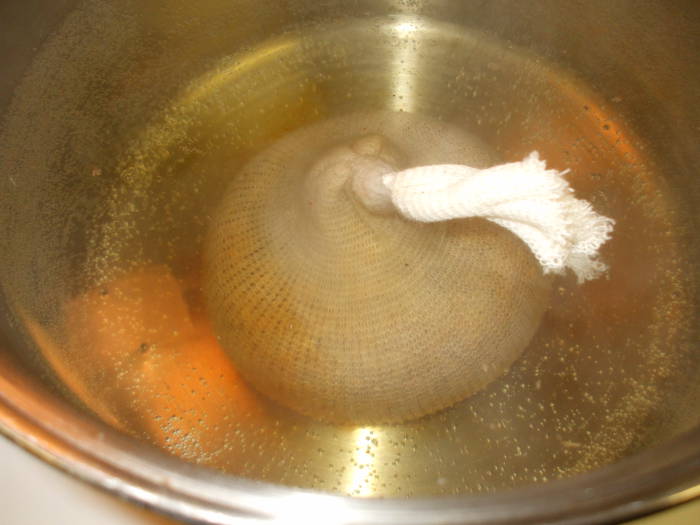
Steeping the orange peel in boiling water: near the end.
Steeping the orange peel in boiling water: at the beginning.

Steep the orange peel by heating 4 liters of water until it just starts boiling. Then place the cheesecloth ball of orange peel into the water.

The water very quickly takes on a light orange tint.

I left the orange peel in at a very low boil for about 30 minutes. The water was noticeably darker by then.

Adding the honey to the boiling must.
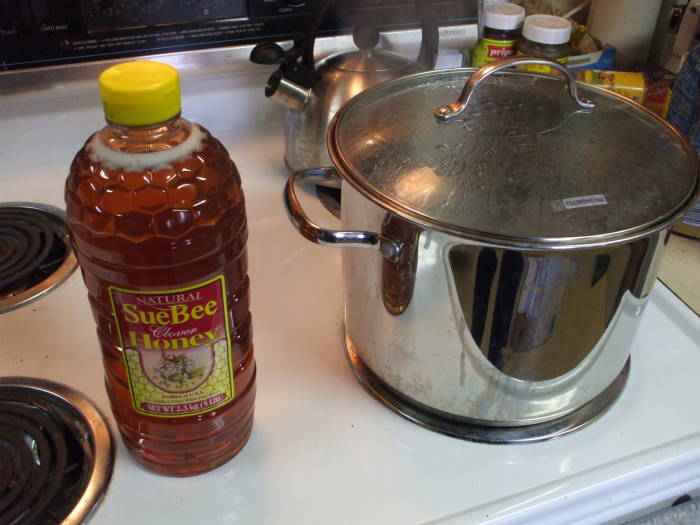
Preparing mead: honey and the boiling pot.

Now it was time to prepare the must, the unfermented honey-water mix. The must is to mead as the wort is to beer, it's the initial liquid heated and mixed before the yeast is added for fermentation.

As my largest pot only holds about 11 liters, I had to prepare the must in batches.

The honey was in three 2.35 kg bottles, so I did three batches of three to four liters of water with one bottle of honey, starting with the 4-liter orange-steeped batch of water.

Heat 3 to four liters of water until it just starts boiling.

Then pour one of the three containers of honey into the lightly boiling water. There is a strange effect as the honey forms a mostly separate layer below the water. You can see it puddling on the pot bottom.

Gloopy oobleck removed from the boiling must.
The boiling must is topped by gloopy oobleck.

There is a lot of debate over boiling mead must. Pro-boiling arguments include:

Anti-boiling arguments include:

As you can see, I'm a boiler. Well, I'm a Boiler, as in a Boilermaker, a Purdue University engineering graduate, and so I don't see that there's any such thing as an over-application of technology.

Anyway, I boiled each must batch for about 20 minutes, enough for adequate pasteurization and to float out all the bees' knees and other hive debris. I spooned out the gloopy blocks of foam.

Once it boiled fairly clean, I added that must to the chilled water already sitting in the fermentation vessel.

3ml Vegemite boiled in 1 liter of water.
Vegemite!  3 ml volume, if you please.

Now speculate on the very sketchy mead guidance provided in The Complete Joy of Homebrewing.

I decided that when they say that "a half-ounce of yeast extract" can provide needed yeast nutrients, they surely meant something like Vegemite!

Dissolve 3 ml (a heaping half-teaspoon) of Vegemite in the final liter of water set aside for this purpose.

Marvel at how such a small amount of Vegemite can taint the color and taste of a large volume of water.

Well, it is a rather pungent and tar-like material...

A bottle of mead
Measuring the specific gravity of mead.

Once the fluid in the fermentation vessel is down to room temperature, measure the initial specific gravity.

Yikes, 1.110!

Hopefully this will be much less nasty than the Viking Malt Liquor I made once.

Time to open a bottle from the previous batch. Yes, I bottle in clear glass bottles. Many people say that you shouldn't do this, but what they really mean is that you shouldn't let light hit your brewed beverages.

I store bottles in case boxes which are enclosed in black plastic garbage bags ("bin bags" if you happen to speak English as opposed to Colonial English), and I am reasonably certain that the light in my refrigerator goes out when the door closes. So, I feel free to use clear glass bottles that let me much better see the contents.

A clear bottle of mead.
A glass of mead
Pouring a glass of mead.

There is a solid layer of sludge on the bottom of the bottle. Remember the picture of the Vegemite? It's that stuff, more or less.

Pour slowly.

Tip the bottle just enough to pour the liquid while not pinching off the air flow above.

Let it pour smoothly, avoid the glug-glug-glug.

Stop before the sludge leaves the bottle. Yes, you lose about a 1 cm layer of liquid. But the result is a clear glass, not something clouded with yeast sludge.

Pitching yeast into fermenting mead.

You are about ready to "pitch the yeast". That is, to add the yeast. I don't know why you're supposed to say "pitch" instead of "add" unless it's some sort of shibboleth.

Anyway, this stuff will become strong. See the initial gravity reading above. The yeast need to be tolerant of higher alcohol levels. Use Champagne yeast if it's available.

I also poured a glass of mead from the previous batch (as seen above) and then swirled its sludge and added that to the fermenter. Who knows, maybe there are still some viable yeast in that sludge. Maybe they're tough yeast beasts that survived fairly high ethanol concentrations followed by several months of storage first at room temperature and then refrigeration.

Now it's time to cap the fermenter and wait for the yeast to multiply into the billions and do their magic to convert the complex sugars of the honey into ethanol and carbon dioxide.

About 80 days later the specific gravity had dropped all the way to 1.008.
As per the magic number of 127 from "The Complete Joy of Homebrewing":
%ethanol = 127*(Δ s.g.)
Or as per Coopers':
%ethanol = 0.5 + 134.05*(Δ s.g.)
The second, higher, value seems more realistic. The two estimate a range of:
12.98% < %ethanol < 14.17%

Siphon into a tapped bucket.

Do not prime, as the yeast is probably all dead due to the ethanol level. I had used champagne yeast, but still...

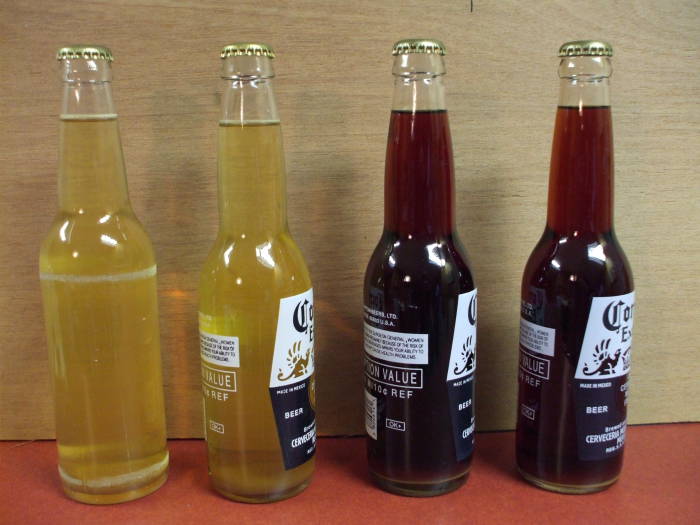
Bottle in the nice clear bottles recycled by Corona drinkers.

Wait a few more weeks....

Enjoy!

Other Mead Recipe Sources

A collection of recipes from Kenelme Digbie in 1669 describe mid-17th-century mead and metheglin making. It's from a book published in London in 1669, "The Closet of the Eminently Learned Sir Kenelme Digbie Kt Opened: Whereby is Discovered Several ways for making of Metheglin, Sider, Cherry-Wine, &c. together with Excellent Directions for Cookery: As also for Preserving, Conserving, Candying, &c." http://realbeer.com/spencer/Digby-recipes/

More recent mead recipes include:


A Beer Recipe — How To Brew Beer

Beer ingredients: liquid and powder malt.
Beer ingredients: bittering and finishing hops.
Beer ingredients: crushed malted grain.

English Pale Ale

This will be a Pale Ale — hoppy, but not so hoppy as an India Pale Ale or IPA.

There will be a 60 minute total boil, 55 minutes with the bittering hops then the final 5 minutes with the finishing hops.

Material:

Method:

Beer brewing: initial water heating.

Start by chilling all but about 6 liters of the water to just above freezing. I did this on a cold day and simply set the plastic jugs of water on my balcony, but a refrigerator would work.

Heat the remaining 6 liters of water to about 85°C (180-190°F).

I used a thermometer to measure the temperature, but "about to boil" or "just starting to boil with 2mm bubbles forming" would be reasonable approximations.

While you're doing that, fill the sink with hot water, remove the label from the liquid malt extract can, and submerge it into the hot water. That will really help it to flow out of the can when you need it in a later step. Without this preparation it's like the proverbial molasses on a cold day. In other words, tremendously frustrating.

Beer ingredients: crushed malted grain.

Put the grain into a sock-like cheesecloth tube and tie it off.

A friend of mine has used an actual sock for this step, but I wouldn't recommend it.

This, of course, depends on the state of your own socks.

My socks are not food-grade by any stretch of the imagination.

Beer brewing: steeping the crushed malted grain.

I simply heated the water to the upper end of the desired range, turned off the heat (this was on an electric range), added the grain bag, and placed a lid on the pot.

Give the grain at least 20 minutes to steep. I left it in for 30 minutes as the temperate dropped slightly from about 88°C to 82°C.

The water took on a light golden color almost immediately, darkening to a brown lighter than that of tea by the end of the 30 minutes.

Remove the bag, allowing it to fully drain into the brew pot, and discard the bag.

Beer brewing: boiling the malt.

Carefully add the very finely powdered spray-dried malt. I have slowly learned that the right way to do this is to bring the water to a very light boil and then add the malt powder a little at a time while stirring.

Add just a little at a time and stir it into solution before adding more. Don't allow it to form floating doughy clumps. And don't dump in a bunch and let the wort take off on a nearly explosive boil-over.

You can add the liquid malt extract after getting the spray-dried powder into solution.

Solution, not suspension. Kinda important. There's no such thing as stirring it too much.

The pot will quit boiling when you add the cooler liquid malt extract. Be careful, stir it thoroughly while you add it and from time to time. Watch the pot to make sure it doesn't boil over.

Beer brewing: adding the hops.

Once you have re-established a stable low boil, it is time to add the bittering hops.

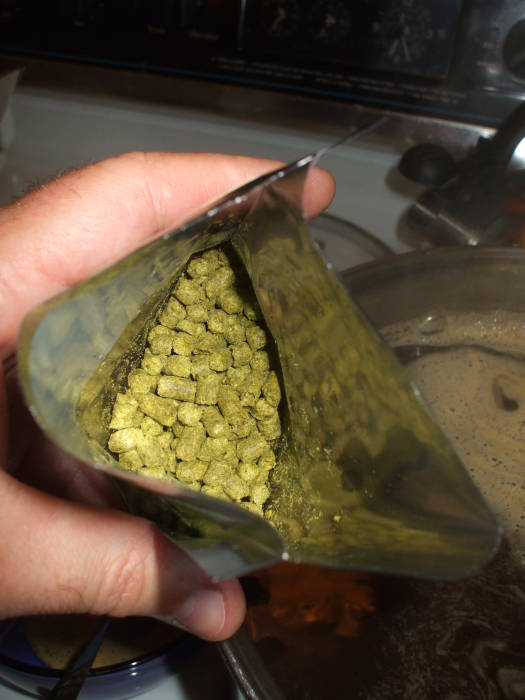
Here you see the hops — vacuum packed hops pressed into pellets.

Just drop them in and stir the pot.

Yes, the hops will form a rather nasty looking layer of chunky green ooblek.

Start a timer — you want to boil the wort for 55 minutes with these bittering hops.

Stir this mess from time to time, "every 5 minutes" according to some.

Beer brewing: adding even more hops.

After 55 minutes of boiling with the bittering hops, add the finishing hops and boil for another 5 minutes.

They look pretty similar to the bittering hops, they happen to be pressed into longer pellets.

The bittering hops had largely disappeared, but these additional hops will cause another burst of surface ooblek. That's fine, stir the whole mess for the additional 5 minutes.

After that additional 5 minutes, so 60 minutes total of boiling with hops, remove the wort from the heat and cool it quickly. I simply placed it in a sink with a stopper in the drain and filled the drain around the pot with cold water.

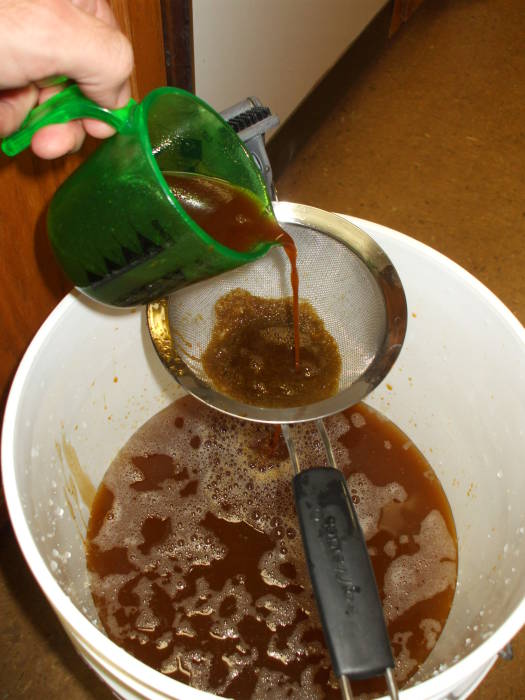
Beer brewing: putting the wort in the fermenter, filtering out the trub.
Beer brewing: filtered trub solids.
Beer brewing: putting the wort in the fermenter.
Beer brewing: putting the wort in the fermenter, filtering out the trub.

Put the chilled water into the fermentation bucket. A total of 15 liters minus the 6 used in the boil, so 9 liters of cold spring water.

Yes, I am using a food-grade plastic bucket of five to six gallon capacity.

And yes, I realize that a bucket is a terribly dangerous device.

As the U.S. Consumer Product Safety Commission is warning us, "Large Buckets Are Drowning Hazards For Young Children."

I have read somewhere that a surprisingly large number of children drown in large plastic buckets in the U.S. in an average year. It seems that there are more children under five who drown in water buckets than there are children under ten who die from accidental gunshots (and don't forget that "children killed by guns" includes active members of the drug trade in their late teens killed in gun fights that they start).

A government crackdown on the private ownership and use of plastic buckets is obviously on the horizon. America is awash in dangerous, unregistered, large plastic buckets in the hands of the public, and, perhaps most shockingly, anyone can walk into a hardware store and buy multiple ones with no background check. I have stockpiled a few. Well, two. Plus a third with a hole cut for a tap used for bottling.

Anyway, pour the liquid wort through a fine-screened strainer to separate out the trub, the oobleck made up mostly of hop solids.

I used a clean plastic measuring cup to scoop out and pour a little at a time.

The trub will clog the strainer, so stir it around with a spoon to allow the liquid wort to pass through into the fermentation vessel. Then dump the trub.

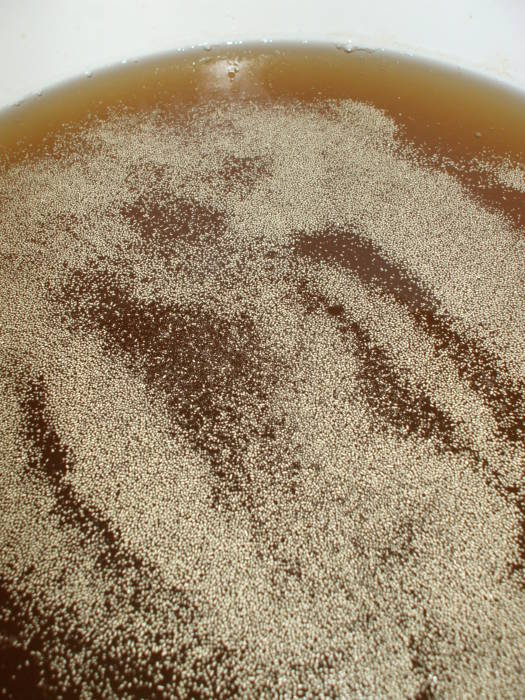
Beer brewing: pitching the yeast before fermentation.
Beer brewing: hydrometer measurement of specific gravity.

I used a baster to extract some liquid from the fermenter and measured an initial specific gravity of 1.038.

Time to pitch the yeast, seal the fermenter lid, and install a fermentation air lock.

Billions and billions of yeast beasts will do the work of converting the malt sugars into ethanol and carbon dioxide.

After a week or two it will be time to bottle the result.


Brewing Log


Brewing History

The best article I've seen on deep brewing history is "Beer and its Drinkers: An Ancient Near Eastern Love Story" by Michael Homan, Near Eastern Archaeology, vol 67 no 2 (June 2004), pp 84-95. http://www.bu.edu/asor/pubs/nea/67_2.html

The Sumerian Hymn to Ninkasi dates from 1800 BCE:

There has been some efforts to re-create Sumerian beer. The Oriental Institute at the University of Chicago reported on this in 1991. That led to an article in Archaeology magazine, July/August 1991, pp 24-33, by Solomon Katz and Fritz Maytag, president of Anchor Brewing Company, and Anchor's report on their project What may be a transcription of this article is available. Another article on this project is "Whatever Happened to Sumerian Beer?".

Then there is Midas Touch, from Dogfish Head, a re-creation of a beer from the era of the historical Midas, from Phyrgia in central Turkey around 730 BC. They worked with archeaological chemist Patrick McGovern of the University of Pennsylvania to re-create a beverage based on honey, barley, grapes, and saffron. They have also made Theobroma, or The Food of the Gods, based on Mayan and Aztec ceremonial drinks using data from residues of the earliest known fermented cacao beverage from 1400-1000 BC. For details, see the New Yorker article, 24 Nov 2008, pp 86-99.

And also see "Symposium: Did Man Once Live By Beer Alone?", Robert J. Braidwood, Jonathan D. Sauer, Hans Helbaek, Paul C. Mangelsdorf, Hugh C. Cutler, Carleton S. Coon, Ralph Linton, Julian Steward and A. Leo Oppenheim, American Anthropologist, Vol. 55, No. 4 (Oct., 1953), pp. 515-526. http://www.jstor.org/pss/663781

Biblical references to beer include the following, where "strong wine" and "strong drink" were used for "beer" in the King James translation:

The Barbarian's Beverage has information on the history of beer in the Near East, Egypt, and the Greek and Roman empires. http://www.ancientbeer.com/

The Economist ran an article "Uncorking The Past" discussing the history of brewing on 20 Dec 2001.

A recipe for gruit ale, pre-hop-era European ale, is available: http://www.fortunecity.com/boozers/brewerytap/555/gruit.htm

Brewery.org has a technical library including historical recipes: http://brewery.org/brewery/Library.html

Some fragmentary information on medieval brewing techniques is available: http://brewery.org/brewery/library/PeriodRen.html

For more general comments on medieval brewing see: http://brewery.org/brewery/library/MedievalFH.html

Other vital brewing-related links:

Everyone needs a jet-powered beer cooler: http://www.asciimation.co.nz/beer/


Back to the technical projects....

Back to Bob's Fun Page....


Home Page Unix/Linux TCP/IP Infosec Travel Radio Site Map Contact
Use /bin/vi! Manipulate images with ImageMagick! Hosted on OpenBSD
Hosted on Apache Valid XHTML 1.1! Valid CSS!
© Bob Cromwell Jan 2009. Created with /bin/vi and ImageMagick, hosted on OpenBSD with Apache.    Root password available here