Bletchley Park

These are some pictures I took during a visit in 2005. For more detail, see the Bletchley Park site at http://www.bletchleypark.org.uk/ and also the virtual tour at http://www.codesandciphers.org.uk/bletchleypark/index.htm

The mansion at Bletchley Park, the UK code-breaking center in World War II.

This is the Mansion at Bletchley Park. It was also know as Station X. The records on the place go back to the Domesday Book of 1086. The present mansion, an odd mix of architectural styles, was built after its purchase by Sir Herbert Samual Leon in 1883.

It passed from the family's hands into a builder, who was planning to tear it down for a housing estate, when Admiral Sir Hugh Sinclair, director of British Naval Intelligence 1919-1921 and founder of SIS, commonly known as MI6, purchased it with his own money.

The mansion and Hut 4 at Bletchley Park, the UK code-breaking center in World War II.

The mansion was soon surrounded by hastily-built structures, referred to as huts and simply numbered.

Here you see the end of the mansion and part of Hut 4. Hut 4 was occupied by Naval Intelligence, it was where they analyzed decrypts of German Naval messages.

Hut 12

At right is Hut 12.

Codebreaker Alan Turing's home at Bletchley Park.

Alan Turing lived in "the Cottage", beside the carriage house and the Mansion.

The turret with the windows at top led to his room. Dilly Knox, John Jeffreys, and others lived in other rooms of the Cottage.

Huts 3, 6, and 1

Left to right, at right:

Hut 3 (red), intelligence: translation and analysis of decrypts of German Army and Air Force messages.

Hut 6, Cryptanalysis of German Army and Air Force ciphergrams.

Hut 1, the first hut, built in 1939.

Hut 6

At left:

Hut 6, Cryptanalysis of German Army and Air Force ciphergrams.

Huts 3 and 6

At right:

Hut 3 (red), intelligence: translation and analysis of decrypts of German Army and Air Force messages.

Hut 6, Cryptanalysis of German Army and Air Force ciphergrams.

Hut 3

Hut 3, intelligence: translation and analysis of decrypts of German Army and Air Force messages

Huts 3 and 6

Hut 3 (red, at left), intelligence: translation and analysis of decrypts of German Army and Air Force messages.

Hut 6, Cryptanalysis of German Army and Air Force ciphergrams.

GCHQ training facility

This training facility was used by GCHQ, the Government Communications Headquarters, basically the UK equivalent to the US's National Security Agency, into, I think, the early to mid 1980s. This is up the rise beyond H block.

It looks like a medium-sized battered elementary school.

D Block and E Block

Here we are walking from H Block down between D Block (visible to left) and E Block (off to right).

H Block

The battered H Block building.

B Block and E Block

B Block at left, leading into E Block.

German wireless station

B Block now contains several exhibits, including this reconstructed German wireless station.

HF receivers used by British Y service intercept operators.

The British Y service intercept operators used these HF receivers to collect the intercepts attacked by the cryptanalysts.

Nazi German cipher equipment: Lorenz SZ42 Schlusselzusatz cipher machine, Lorenz T32 teleprinter

Here is some Nazi German cipher equipment.

At left: Lorenz SZ42 Schlusselzusatz cipher machine.

At right: Lorenz T32 teleprinter.

Bombe, rear, opened

The British cryptanalysts build a functional replica of the German Enigma machine, following the work done by the Poles before them. This shows the opened rear of a bombe.

The device was called a Bombe, and two explanations are given for its name:

First, and probably most likely, this was the designed by the Polish mathematicians turns cryptanalysts as they discussed the problem over an ice cream dish known as a bomba.

A less convincing claim is that the name had to do with the ticking sound made by the machine as it worked through the possible keys, stopping and ringing a bell when it found a solution.

Bombe, rear, opened

Here is a closer view of the rear of an opened Bombe reconstruction.

Bombe, rear, opened

And a side view of the rear panel of an opened Bombe....

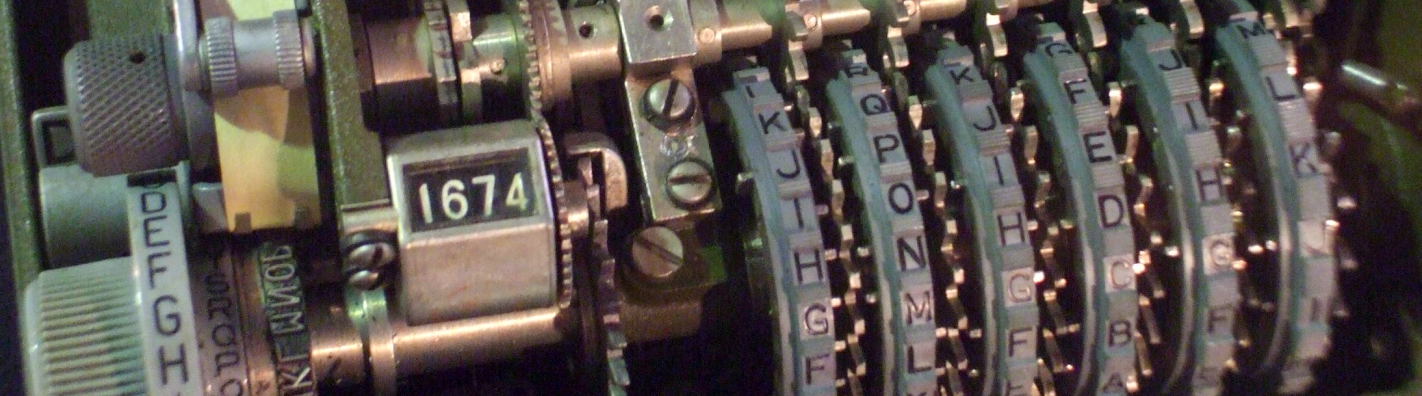
Bombe, front, showing rotors

The front panel of a Bombe held an array of drums simulating Enigma rotors. Each colume of three drums simulates one 3-rotor Enigma machine, or for the point of the Bombe, one possible initial setting of a 3-rotor Enigma machine.

Hut 8

Hut 8, where Naval Intelligence analyzed the decrypts of German naval messages.

Hut 8

Hut 8, view into window

Huts 6 and 1

Hut 6 (at left), cryptanalysis of German Army and Air Force cryptograms.

Hut 1, the first hut built.


That's it, for far more detail see the Bletchley Park site at http://www.bletchleypark.org.uk/ and also the virtual tour at http://www.codesandciphers.org.uk/bletchleypark/index.htm

Scotland and Orkney

People ascending Ben Nevis near Fort William in Scotland, the highest peak in the Scottish Highlands and in all of Britain.

An ascent of Ben Nevis, the highest mountain in Britain, overlooking Glen Nevis just outside Fort William.

The Road to the Isles, over 22 miles (37 km) overland across the high Scottish moors of Lochaber from Corrour Station to Fort William.

The Road to the Isles, over 22 miles (37 km) overland across the high Scottish moors of Lochaber from Corrour Station to Fort William.

Crossing a 3-wire bridge while trekking through Glen Nevis and the Water of Nevis.

A trek through Glen Nevis and the Water of Nevis.

The Brealach Walk out of Pitlochry though the Highlands past megaliths.

The Brealach Walk out of Pitlochry though the southern Highlands and past some megaliths.

Neolithic dwellings exposed on the beach at Skara Brae in Orkney.

Skara Brae, a Neolithic village on Orkney.

Neolithic Orkney: Maeshowe, the Ring of Brodgar, the Stones of Stenness, the Knowe of Onston.

Neolithic Orkney: Maeshowe, the Ring of Brodgar, the Stones of Stenness, and the Knowe of Onston.

Geos and freestanding stone pillars along the sea cliffs of the west coast of Orkney.

West Coast Walk along the sea cliffs of Orkney's Mainland Coast.

Scapa Flow and World War II naval fortifications in Orkney.

Scapa Flow and the Churchill Barriers.

The sousterrain, an underground Pict dwelling in Orkney.

The Sousterrain, an underground Pictish dwelling in Orkney.

Church yard on the Isle of Iona in the Inner Hebrides islands off the coast of Scotland.

The Isle of Iona, and Oban and Mull.

Grit box on Orkney. Grit box on Orkney.

The Grit Boxes of Scotland.

Ordnance Survey map of the peak of Ben Nevis.

Navigating with the UK National Grid system and Ordnance Survey maps.

England

Walking along the central section of Hadrian's Wall in Northumberland.

Walking along Hadrian's Wall in Northumberland.

Stonehenge.

Stonehenge, Woodhenge, and Durrington Walls.

Avebury.

Avebury, with its stone circles, Silbury Hill, the West Kennet Long Barrow, the Avenue and numerous tumuli, a much better collection of megaliths and structures than Stonehenge!

The Eagle and Child pub at Oxford, where C.S. Lewis, J.R.R. Tolkien, and the rest of the 'Inklings' gathered to discuss literature.

C.S. Lewis and J.R.R. Tolkien at Oxford.

World War II and Cold War tunnels in the White Cliffs above Dover.

Dover's tunnels in the White Cliffs from World War II through the Cold War.

The Chain Home World War II radar towers at Swingate outside Dover.

The Swingate Chain Home radar station near Dover.

The World War II glider base near Harwell, south of Oxford.

The World War II glider base near Harwell, south of Oxford.

Bletchley Park, the Allied cryptanalysis center outside London during World War II.

Bletchley Park, the secret installation where the British broke the German codes during World War II.

The Cabinet War Rooms in London.

The Cabinet War Rooms, Churchill's emergency World War II government center underground in central London.

Lee Ho Fook's restaurant in Chinatown, made famous by Warren Zevon's 'Werewolves of London'.

You could go to Lee Ho Fook's and get a big dish of beef chow mein.

Stainless steel urinal in a pub in London.

What's the plumbing like?

Travel in the U.K. — places to stay, how to get around

Travel in general

My historical INFOSEC page

My information security page

"Just Enough Cryptography" page

Click here to inquire about advertising on this or any page on this site.
Home Unix/Linux Networking Cybersecurity Travel Technical Radio Site Map Contact


Use /bin/vi! Manipulate images with ImageMagick! Hosted on OpenBSD
Hosted on Apache This site is viewable with any browser Valid XHTML 1.0! Valid CSS!
© Bob Cromwell Feb 2012. Created with /bin/vi and ImageMagick, hosted on OpenBSD with Apache.    Root password available here, privacy policy here.
