Greece |
|
All the travel marketing for Greece seems to show one of two things: The Parthenon, on the Akropolis in Athens, or the island of Santorini.
Let me go ahead and get one of them out of the way right now....
Greece is pretty easy to get around, if you are patient with the land tranportation. Ferries around the Aegean are frequent, fast, and cheap. It's the buses and trains that can be infrequent and slow. At least they're also cheap!
For transport within Greece, bear in mind that the two bus stations in Athens are inconveniently located. The bus lines use vehicles roughly comparable to those of Syria.
The trains are much more pleasant, if you're going somewhere they reach (e.g., Corinthia, or Olympia, but not Delphi). They're about like Egyptian trains, in terms of quality.
Dromologia (Train Schedule) — Really you'll want to get a current schedule at the train station. The times changes, and there are many more stops than these. The below is just listed for planning day trips to Corinthia, or trips to/from Olympia, Patra, Corinthia, and Athens. Hopefully you can read Greek, you'll need to.... Bold ones below are Inter-City trains, nicer and faster (well, less slow, given that we're talking about narrow-gauge Greek trains).
| Athens / Αθηνα | 0629 | 0700 | 0724 | 0849 | 0937 | 1035 | 1207 | 1406 | 1507 | 1526 | 1603 | 1820 | 2219 | 2310 |
| Corinthia / Κορινθια | 0819 | 0831 | 0919 | 1022 | 1135 | 1226 | 1339 | 1539 | 1700 | 1720 | 1753 | 1953 | 2359 | 0057 |
| Patras / Πατρα | 1044 | — | — | 1215 | 1418 | — | 1533 | 1734 | — | 1957 | — | 2147 | 0212 | — |
| Pyrgos / Πυργοσ | 1249 | — | — | 1353 | 1631 | — | — | 1913 | — | 2201 | — | 2324 | 0406 | — |
| Pyrgos / Πυργοσ | 0630 | 0859 | 1139 | 1410 | 1920 |
| Olympia / Ολυμπια | 0706 | 0935 | 1215 | 1446 | 1956 |
| Olympia / Ολυμπια | 0721 | 0946 | 1230 | 1552 | 2005 |
| Pyrgos / Πυργοσ | 0757 | 1022 | 1308 | 1628 | 2041 |
| Pyrgos / Πυργοσ | — | 0529 | — | 0822 | 1046 | — | 1137 | — | — | 1700 | 1912 | — | 1757 | — | — | 0034 |
| Patras / Πατρα | — | 0702 | — | 1019 | 1218 | — | 1346 | — | — | 1833 | 2128 | — | 1953 | — | — | 0218 |
| Corinthia / Κορινθια | 0728 | 0900 | 1205 | 1252 | 1417 | 1611 | 1659 | 1829 | 1954 | 2033 | — | — | 2224 | 2117 | 0348 | 0441 |
| Athens / Αθηνα | 0918 | 1032 | 1355 | 1446 | 1549 | 1800 | 1900 | 2001 | 2142 | 2204 | — | — | 0016 | 2248 | 0534 | 0619 |
As for getting to the islands, the standard way to get around is on the ferries. Pretty cheap — about € 10 for an all-day ride (e.g., Athens to Santorini), maybe € 4 for a hop to the next island.
However, remember that communism is alive and well in Greece (note all the red hammers and sickles painted all over Athens), and ferry strikes are common. Schedules more than a day in advance may be no more than suggestions. Also, in the fall of 2000, they actually managed to sink a ferry by running into a set of rocks topped with a lighthouse! Apparently the captain was asleep in his cabin, and the rest of the bridge crew was below watching a football game on TV.
My experience is that there are two seasons in Greece:
Aphrodite's House has beds in shared and private rooms
for not very much:
Aphrodite's House
12 Eynardou Street
(by the corner of 65 Mikhail Voda Street)
Athens, Greece
+30-88-10-589
+30-88-16-574 (fax)
http://www.hostelaphrodite.com/
Take the metro to the Viktorias station. Cross the park, continue down the hill on the street that T's into the park. The second stoplight should be Mikhail Voda, turn right. Find the Atlantik grocery store at #65, Aphrodite's House is right behind it. On the other hand, if you're at the train station, you're within a few blocks. Walk east until you hit Mikhail Voda, then turn north (left).
Aphrodite's has a basement bar, but it's about twice the cost of sitting at a sidewalk cafe or taverna in the Plaka district at the base of the Acropolis! To get there to the Plaka and its tavernas:
Take the metro to the Monostiraki stop, at the edge of the Plaka. Just east of the metro station are some restaurants with sidewalk seating. Two face the station across a square. The other is Savvas, just beyond that, up the alley toward Syntagma Square. Both have great food and drink at reasonable prices.
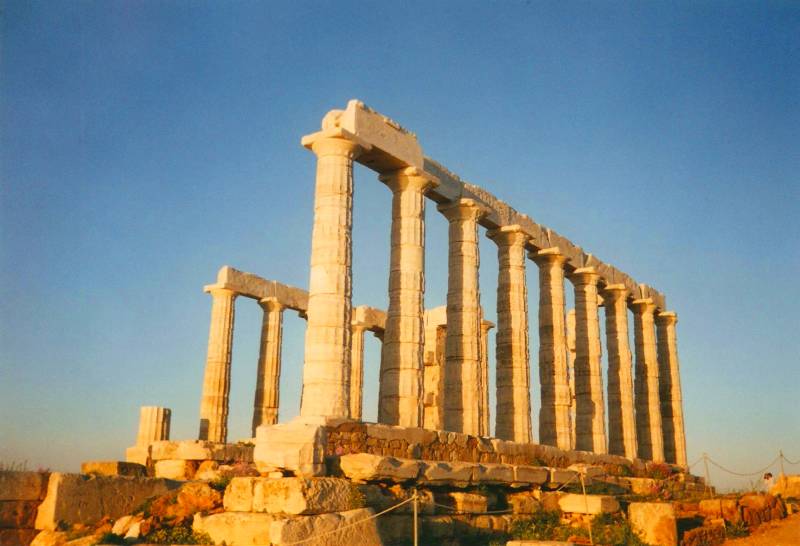
Take a day trip out of Athens to Cape Sounion. You can take a bus, I think they still leave from near the Viktorias metro station.
Go out to Cape Sounion in the afternoon, and if possible, hang around until sunset.
But be careful — make sure that you know when the last bus leaves for Athens, and make sure that you are on it!
Corinthia is possible as a long day trip out of Athens, or there are plenty of places to stay overnight there. I have stayed at the Akti Hotel, not too far from the train station and the waterfront. The train runs along the cliff faces above the Saronic Gulf on the way between Athens and Corinthia.
Just before you get into Corinthia, you cross the Corinthia Canal. It's at the town of Isthmus, which is where we get the word for a narrow strip of land connecting two larger land masses.
The canal was started under Periander in the 7th century BC, but it was only finished in 1881-1893. It's just 6.3 km long, but it saves a 400 km journey around the Peloponnesus! That is, if your vessel can fit into a 21-meter-wide canal...
In Corinthia, walk into the center of town from the waterfront, to the central park. Buses leave frequently from there to go to the ancient city of Corinthia.
From here you can walk up to Akrokorinthos, seen behind me in this picture, to the site of the ancient temple complex.
Also see another page of mine for some pictures from the ruins of ancient Corinthia.
The view from the top of Akrokorinthos is spectacular!
This is the view to the northwest, over the Gulf of Corinthia and generally toward Delphi.
This is the view to the northeast, across the Isthmus and over the Saronic Gulf toward Athens.
If you stay overnight in Corinthia, then you can do a day trip out of there to Mycenae.
There is nowhere good to stay at Mycenaea, it's out in the country. I took a bus out of Corinthia, which was continuing south to Argos. I told the driver where I was going, and he let me out at a restaurant near a road intersection along the main highway. From there it was a walk of about a kilometer to the site.
This is fairly deep history, Mycenae was a power about 1600-1100 BC, and was one of the sides in the Trojan War.
This is the Lion Gate.
This is the Tomb of Clytemnestra.
See the Wikipedia pages on Mycenae and Mycenaean Greece for far more.
From Athens or Corinthia take a train through Patra to Pyrgos. There you change to an even smaller narrow-gauge train for Olympia.
You're looking for Olympia, on the Peloponnesus, and not Mount Olympus, north of Athens!
This was the site of the athletic contests back in the day. The "Olympic Games" as they were called. (This was before today's corporate sponsorships, and even before East German steroid-fueled domination.)
Here you can see the main stadium.
It was also the site of the Temple of Olympian Zeus, one of the Seven Wonders of the Ancient World.
Like all of them except the Giza complex of the Pyramids and the Sphinx, it's just ruins today.
Go to Delphi and spend at least one night there.
So many people zip in on a bus for a whirlwind visit and leave after an hour or two. That wastes a wonderful opportunity.
Greek sacred sites were very carefully chosen for their setting, and Delphi is in a very dramatic mountain valley.
Get a place to stay (the Hotel Pan had a good deal for a single room with my own bath and toilet when I was there).
Visit the temple complexes throughout the day, at various times.
Have a nice dinner, and hang out in a taverna. The balconies extend out the back overlooking the valey all the way down to the Gulf of Corinthia.
Watch the light change as the sun goes down.
This is it — the Temple of Apollo, the site of the Delphia Oracle and the location of the Omphalos Stone, the center of the universe.
Some recent archaeological and geological research suggest that the Oracle's strange behavior may have been caused by ethylene gas emitted from the ground below the temple. See:
The nearby Tholos.
One thing you will notice in Greece are the roadside shrines.
Leaving Piraeus, the port of Athens, early in the morning.
You enter the caldera of Santorini about eight hours later.
Also known as Thira or Thera (or, really, Θηρα), this is the remains of a large volcanic island, the southernmost of the Cyclades island group.
Santorini was a conical volcano forming a roughly circular island maybe 15-20 km in diameter. Sometime between 1650 and 1500 BC, it exploded in one of the largest volcanic events in history. Something like 61 cubic kilometers of magma and rock were expelled.
The resulting tsunami and ash clouds may have ended the Minoan civilization [see J. Archaeol. Sci. v35, no191 (2008)] There are theories that it was connected to the exodus of the Jews from Egypt. See the Wikipedia articles on Santorini and on the eruption itself for far more details. Also see:
Arriving at the ferry dock. This is in the deep central caldera, below the main town of Fira.
Owners of small pensions meet the ferry. You should have no trouble finding lodging, and at a good rate, if you're there outside the high season.
Yeah, there's a hostel in Fira, but in May or September you can get a nice private room on a pension for less than a bed at the hostel!
A view across Fira from the north, on the path toward Oia.
A view across Fira from the balcony of a taverna.
Another taverna along the caldera rim.
Some people visit the Greek islands on cruise ships.
Those people are properly known as "fools".
The cruise ships, which are effectively floating veal-fattening pens, herd people onto an island for a whirlwind visit.
"There is the cathedral, the souvenir shops are over there, make sure that you're back here in two hours so we can get you back onto the ship."
They're back on board and at the buffet, out of harbor and over the horizon before the sun sets.
Meanwhile you're still sitting at the taverna watching the sun set.
You can take a bus to Perissa, on the south-eastern outer shore of the island.
Then hike up to Ancient Thera, about 300-350 meters up.
From there continue on up to Moni Profiti Ilia, the Monastery of the Prophet Elijah, which shares the peak with a military radar installation and lots of radio relay gear. Some VHF troposcatter antennas pointing south toward Crete. The peak is at 564m.
The view down over the east coast of the island, and down on an airplace approaching the airport.
Looking back toward Perissa from Moni Profiti Ilia.
Patmos is very nice.
Very small, not many visitors.
And who knows, maybe you will have some apocalyptic visions?
This is where The Revelation of Saint John the Divine was written.
"I, John, your brother and companion in the suffering and kingdom and patient endurance that are ours in Jesus, was on the island of Patmos because of the word of God and the testimony of Jesus." — Rev 1:9.
Rhodes is very nice at night in October, when the tourists are gone and the whole place is like something out of an Errol Flynn movie. In the daytime when the cruise ships are in port, or apparently most anytime in the high season (July and August), it's unpleasantly crowded.
This is the site of the Colossus of Rhodes, the other of the Seven Wonders of the Ancient World to have been in today's Greece.
Fanciful representations have it straddling the harbor opening.
Really it was a tall statue that stood on one side or the other — where you now find these two columns holding stags.
There is a nice hostel, really more of a pension, in the old city. Here's the exterior view, and its courtyard.
Go through one of the immense gates in the old city walls from the dock, turn right (west). If the first square with a fountain you encounter isn't Plateia Hippocrates, it will be the next one in the same direction. Keep going that way on Soukratous, which will go up a gentle slope. About a hundred meters from that fountain, an old mosque stands out over the left half of the street. Turn left under that overhang, the hostel is at 12 Ergiou, and the entrance will be a door down a side alley to your right.
Party party party!
Or so the theory goes....
But there's really not an ethylene seep to be found anywhere on the island.
Yet another place that's pretty quiet out of the high season, but still really nice.
Drink retsina. Yeah, it's a little like wine with turpentine, but not very much. Be very wary of ouzo. Or carry lots of analgesics.
A couple of views of Naxos.
Yet another beautiful island.
|
||||||||||||
|
||||||||||||