Mexico
|
Table of Contents: |
|
Hotel Isabela is a great place to stay. Nice rooms, has a restaurant and cantina, centrally located very close to the Zócalo. There are a lot of little restaurants and taquerias in the area.
Hotel Isabel
Isabel la Catolica No 63
Mexico, DF, 06000
55-18-12-13 y 55-18-12-17
http://come.to/mexhotels
hisabel@prodigy.net.mx
Here's the hotel and the view from the window.
Just west of that hotel on El Salvador between Bolivar and Eje Central Lázaro Cárdenas is what would appear to be the daily Dayton Hamfest of electronics. Stereos, cell phones, antennas, cable, connectors, electronic components, and more. I picked up a very nice multimeter that also measures inductance and capacitance, and tests transistors, for about one-tenth the price I would expect.
Things to see and do in D.F.:
The Aztec ruins of Tenochtitlán are just off the Zócalo at the center of Mexico City, more properly known as Ciudad de México, or simply as D.F. (for Distrito Federal).
Formally, the Zócalo is Plaza de la Constitución, but everyone simply calls it the Zócalo. It has been the central gathering place since Aztec times, and the name is used for the main square in many Mexican towns.
Native dancers perform on the Zócalo. Behind them is the Palacio de Ayuntamiento at the southwest corner of the Zócalo, the city's seat of power since the Spanish conquest.
This is the corrida, or bull-fighting ring.
Blood!
Gore!
I saw a minor-league bullfight. There were three toreadors, one of whom was good, and one of whom seemed to be whittling the bull to death.
Finally the bull-ring staff member I refer to as the Bovine Angel of Death steps in. One stick in the neck with what would appear to be a steak knife, and the bull falls down dead.
The Ciudad de México stray dog report:
Pulque! |
Pulque is a traditional beverage made from fermented agave sap. It's thick and slimy, like celery and grass clippings and Elmer's glue and a little tequila spun in a blender. It's kept in wooden barrels behind the counter and served up with a big metal ladle.
Pulque is somewhat hard to find. You have to find a pulqueria in Mexico as it isn't exported. In fact, you have to find a pulqueria in the right region of Mexico, as it isn't transported very far even within the country.
One pulqueria in Ciudad de México is the Pulqueria de los Dualistes across the street to the east of the Mercado San Juan.
The Pulqueria de los Dualistes is a typical example. It's fairly grungy — the front corner is a separate room (with separate entrance from the street) for women and families. The main room has a urinal in the corner, and a toilet in a stall.
They had four varieties of pulque — the two most popular were blanco and curvado (white and green). They also had pink and magenta. It's served up in 20-ounce mugs for M$8. We learned later that you can get a half-size vasa.
What they really need is the pulque sampler — a tray with a small glass of each flavor.
Teotihuacan is a very impressive ancient religious center with enormous pyramids. It's an easy day trip out of Ciudad de México.
Teotihuacan was the largest city in the Americas at its peak from 150 to 450 CE. It probably covered over 30 square kilometers and had more than 150,000 inhabitants, possibly 250,000, making it among the largest cities in the world at that time.
One of the strange things about the place is that we don't know the name of the city! Teotihuacan is the Nahuatl name applied by the Aztec centuries after its fall.
The Pirámide del Sol is the third-largest pyramid in the world, by volume. It's 70m high, 220m along each face of the base, thus with a slope of about 33 degrees on each face. It was completed by 100 CE.
At one end of the long complex is the Pirámide de la Luna, not quite as big but still huge.
At right we're on top of Pirámide del Sol and looking toward Pirámide de la Luna.
Here you see Pirámide de la Luna and some of the relatively smaller (but still quite large!) ritualistic structures.
At right we are on top of Pirámide de la Luna and looking toward Pirámide del Sol over the many smaller ritualistic structures.
At left is a sculpture depicting Quetzacoatl, the Great Winged Serpent. He was a Mesoamerican diety whose name, in the Nahuatl language, literally mean Feathered Serpent.
Tepoztlan can be visited as a day trip out of Mexico City. It's a couple of hours by bus to the south. Just be very careful about the return bus schedule!
Tepoztlan is up in the mountains and semi-tropical. Many of the locals speak Nahuatl, the Aztec language.
Nahuatl was the language of the Aztecs, and it has been spoken at least since the 7th Century in central Mexico. It and other indigenous languages of Mexico are recognized as lenguas nacionales or "national languages" and have the same status as Spanish within their regions of use.
On the one hand, it's an exotic language with a complicated system of agglutination forming long words with complex meanings. But on the other hand, a number of words in Spanish and English come from their Nahuatl originals. There were many things that the Spanish explorers first saw in Mexico, and when they asked what they were, got the Nahuatl name. These include: avocado, chili, chocolate, coyote, guacamole, mesquite, mezcal, peyote, shack, and tomato. Click here for a list.
Tepoztlan is the legendary birthplace of Quetzacoatl, the Great Winged Serpent, around 800 CE. There are high cliffs over the town to the north, 400-600m high. Up the cliff 400m above the town is the 10m-high Pirámide de Tepoztéco, honoring Tepoztécatl, the Aztec god of harvest, fertility, and pulque.
Pirámide Tepanapa, or Pirámide Tlachihualtepetl, the Great Pyramid of Cholula, is the largest pyramid in the world as measured by volume — 3,000,000 to 4,500,000 cubic meters. By the 4th century CE it was 65m high and 450m along each side of its base.
Tlachihualtepetl is Nahuatl for artificial mountain.
Around 600 CE Cholula fell to the Olmeca-Xicallanca. Between 900 and 1300 CE, Toltecs and/or Chichimecs took over. Later, it fell to the Aztecs. By 1519 the pyramid was already overgrown.
Now it looks like an isolated abrupt hill with a church at the peak. The church of Nuestra Señora de los Remedios was heavily damaged in a 1999 earthquake.
There are over eight kilometers of tunnels through the pyramid. With a ticket you can go through it, although side tunnels are gated off. Tunnels lead both up and down at angles into the pyramid, extending as far as you can see.
The Zona Arqueológica includes the Patio de los Altares, which was the main approach to the pyramid back in the day and, as it name indicates, an area of worship.
Cholula's local speciality is cemitas — a sandwich on a big sesame bun rather than a tortilla. The bun is spread with a whole avocado, then stuffed with chicken grilled and shredded, stringy white cheese, onions, and green peppers.
A bus from Ciudad de México to Cholula costs maybe M$40-50 and probably goes via Huejotzingo.
Cholula is a hotbed of lucha libre, masked wrestling!
Mascara Magica!
Tarzan Boy!
Gigante Silva!
Virus Hipnosis!
The city of Puebla is close to Cholula and also interesting, although I preferred Cholula.
| Tecate is a nice town just an hour or two by bus from the mess that is Tijuana. There is no particular reason to visit, which is the reason to visit. |
|
|
There is a shaded zócalo at the center of town,
Parque Hidalgo.
It's a nice place to sit at the tables outside a
cantina and watch the people.
And yes, the town's name was given to the brewery that is one of the main employers. So this is a little like visiting Miller, Wisconsin or Budweiser, Missouri. There are plenty of well-supplied cantinas. |
|
|
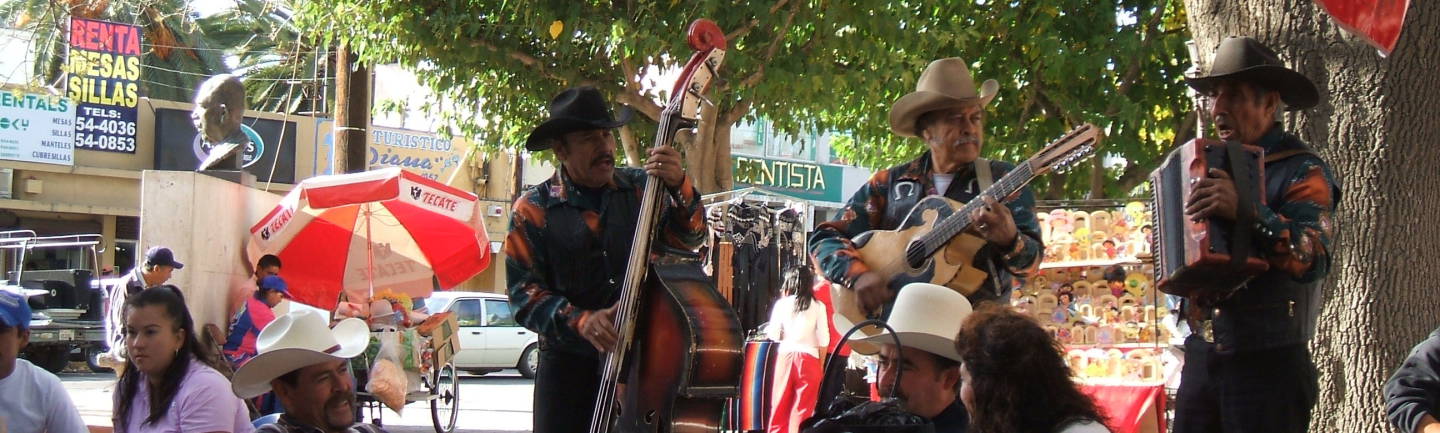
The mariachis sell songs of love and death
on the shaded zócalo.
|
|
|
These men can wear cowboys hats and look right,
unlike the many midwestern and south-eastern
Americans who wear them as a costume.
If you have no real business wearing a cowboy hat but you insist on wearing one anyway, then you really ought to also wear a pair of Roy Rogers toy cap pistols. No point in looking just a little bit stupid. I'm talking to you, country musicians. These guys, however, can pull it off! ¡Muy authentico! |
|
|
|
|
|
The Motel Paraiso is a nice place to stay.
It's just five blocks west of Parque Hildalgo along Avenida Juárez. If you're just arriving in Mexico, you can get pesos from the ATM half-way between the hotel and the park along Avenida Juárez. Motel Paraiso Calle Aldrete 83 +1-665-654-1716 Or look here: http://www.allmexicohotels.com/baja-california/tecate/ |
|
Ensenada is a playground for gringos a couple of hours south of Tijuana by bus.
If you're going to visit, the Hotel Plaza Fiesta is a nice place to stay. It's the big pink building on the left in the first picture.
|
Ensenada mostly caters to the cruise ships. My theory is that cruise ships are a complicated Norwegian plot to increase the world-wide hatred of Americans.
Think about it — they pack their floating veal-fattening pen with not particularly impressive specimens. They get their passengers all liquored up and convince them that nothing really matters, anything goes, and "it all stays on the boat". Then they sail into a foreign port.
The passengers swarm into town like a plague of locusts, eager to "sample the local culture" in their alloted two to four hours. In Ensenada, this means:
Go on, I would bet that now you cannot help but picture this guy wearing nothing but his "mariachi hat" and a thin glistening coating of vanilla extract.
|
|
|
|||||||||
|
|||||||||
|
| © Bob Cromwell Aug 2010. Created with /bin/vi and ImageMagick, hosted on OpenBSD with Apache. Root password available here, privacy policy here. |