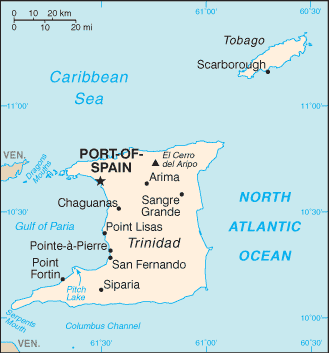
CIA map of Trinidad and Tobago.

Trinidad and Tobago

Traveling and Working in the Caribbean

Trinidad flag

Here are lot of pictures and some stories about my trip to Trinidad!

Now to be honest, I've only been to Trinidad and haven't been to Tobago. But from what little I've seen, I got the idea that many of the people who went to Tobago were there to stay within their resort compounds. I was in Trinidad, mostly in Port of Spain, and as you'll see below, interacting exclusively with the locals. I didn't see another American until I returned to the airport to fly out.

I had a job there doing Unix security for TSTT, Telecommunications Services of Trinidad & Tobago, the T&T telecom company. And due to another work commitment, I couldn't stay on very long after the job was done. So no Tobago, and only very little Trinidad — just Port of Spain and the surroundings. I'm afraid you'll have to look elsewhere if you need Tobagan information.

I found The Rough Guide to Trinidad & Tobago to be very helpful for planning my trip, understanding what I was seeing, and even picking up some of the local terminology with which I could delight the locals.

They would ask me what I had done the evening before, and I could tell them first I took the maxi-taxi to town and changed clothes. I had a casual lime (and it was a sweet lime), and then I went to get a roti. I heard the engine room in the mas camp really pounding it out, mon. And so on.

USGS map of the Caribbean showing Trinidad and Tobago.

The Rum Diary, by Hunter S Thompson, is about Puerto Rico, but all the same it might give you some idea of what island life is like. It's great writing, whether you're headed to the tropics or not.

Above is a U.S. government map of Trinidad and Tobago. At right is a map showing where Trinidad and Tobago lie just off the Venezuelan coast at the south-east corner of the Caribbean.

It's just 11 km from Trinidad to the northeastern coast of Venezuela. It's 130 km north to Grenada, the first island you would reach in the the Grenadines, and from there on north along the arc of Antillean islands.

Trinidad and Tobago are not part of the arc of Antillean islands. Trinidad is on the South American continental shelf and was once, in a time of much lower sea levels, part of the South American landmass.

The first settlers arrived from northeastern South America around 5000 BC. These people, called Archaic or Ortoiroid, had not yet mastered either ceramic technology or agriculture.

Ceramic-making people called the Saladoid arrived around 250 BC. From here they continued north through the other Caribbean islands.

A third group, the Barrancoid people, arrived from South America after 250 AD.

A new group called the Mayoid cultural tradition arrived around 1300, largely replacing the existing cultures. The Mayoid culture was predominant when the Europeans first arrived in the form of Christopher Columbus' third expedition in 1498. This group included the Arawak-speaking Nepoya and Suppoya peoples, and the Carib-speaking Yao people.

The natives were largely wiped out under the encomienda system of the Spanish colonizers. This system was basically slavery, in which the Spanish forced the natives to work in exchange for Spanish "protection" and conversion to Christianity.

Spanish rule and immigration by Martiniquin planters continued until the Spanish surrendered to a British fleet in 1797. This left Trinidad a British crown colony with a French-speaking population and Spanish laws. Slavery was ended ten years later. That left Trinidadian planters short on labor, so they imported workers starting in the 1830s and continuing until 1917. The first waves of workers were free West Africans, Chinese, and Portuguese from Madeira. Starting in 1839, indentured servants from India were transported to Trinidad.

ONC aeronautical map of Trinidad and Tobago and the northeastern Venezuelan coast

At right is a cropped section of an aeronautical chart, an ONC or Operational Navigation Chart published by the U.S. Department of Defense. It has been cropped way down to show just Trinidad and Tobago and some of the nearby Venezualan coast. It has also been downsampled to 50% of the original resolution. It's from the great Perry-Castañeda Map Collection at the University of Texas library.

Below is a section of that same chart, further cropped and at full original resolution.

Piarco International Airport is the main national airport. It's a 25 km drive outside Port of Spain, in the Piarco Savannah south of the main mountain ridge running along the north side of the island. It housed the U.S.A.A.F. Sixth Air Force during World War II, when it was used as a transport airfield and for antisubmarine patrol flights over the southern Caribbean. It was expanded in 2001 and now has a 10,500 foot runway.

The Chaguaramas peninsula extends to the west of Port of Spain. The entire peninsula was leased to the U.S. in 1940 for the construction of a naval base. During the early 1960s it was a BMEWS early warning radar site and a missile tracking site for the U.S.A.F. Eastern Test Range. The U.S. military operation was scaled back in 1956, and the peninsula was returned to Trinidadian control in 1963.

The national government still has several facilities here. The TSTT facility where I worked was near the radio tower marked on the map (at the eastern edge of the marked MKR6 special-use air space).

ONC aeronautical map of Trinidad

Now for my pictures. The images are thumbnails, click on them if you want more detail.

View from a business hotel in Trinidad.  Nice guest rooms, top-floor restaurant and bar.

Here is the view from a top-floor restaurant in a hotel in Port of Spain. Trinidad is tropical and parts of it are mountainous.

Trinidad has three mountain ranges running east to west. They are continuations of the Venezuelan coastal cordillera.

The Northern Range, rising from the north side of Port of Spain, has the highest terrain in Trinidad. El Cerro del Aripo rises to 940 meters or 3,085 feet. What you see here are the southern slopes of the Northern Range, on the north side of Port of Spain.

Trinidad's past as the edge of the South American continent gives Trinidad a greater variety of tropical vegetation and wildlife than most West Indian islands.

A colonial mansion in Trinidad, one of the 'Magnificent Seven', and architecturally very strange.

Killarny is a colonial mansion along Maraval Road beside the Queen's Park Savannah, one of the Magnificent Seven such mansions. It's also known as Stollmeyer's Castle.

Of this one an architectural critic said, "A German built a bit of an untypical Scottish castle in Trinidad and called it by an Irish name. He must have been by that time a Trinidadian, because only Trinidadians do these things."

A large white mansion, Whitehall, the Prime Minister's office in Trinidad.

Whitehall is also a colonial mansion along Maraval Road beside the Queen's Park Savannah and another one of the "Magnificent Seven". Whitehall is the Prime Minister's office.

I saw the Prime Minister's motorcade leave work one afternoon. He waved to everyone along the street. That's very much the friendly Trini attitude!

 
Dilapidated colonial mansion in Trinidad: ornate wood trim, gables and cupolas, tropical trees.

Here is another one of the "Magnificent Seven", those colonial mansions along Maraval Road beside the Queen's Park Savannah.

Coconut vendors in Trinidad.  A man is selling a large pile of green coconuts out of the back of a battered old red truck.

Coconuts! Get your coconuts!

These coconut vendors are on Maraval Road beside the Queen's Park Savannah. It seems that you can buy fresh coconuts along this road every night that coconuts are in season. I have no idea just when coconut season might be, but I was here in late January. You can see that coconut temperature is an important feature touted by the vendors — "Sonny's Ice Cold Coconut", "Tony's Ice Cold Coconuts", and "Johnny's Ice Cold Coconuts".

Coconut vendors in Trinidad.  A man is selling a large pile of green and brown coconuts out of a cage on the back of a blue truck.  His sign says 'Sonny's Ice Cold Coconut'. Coconut vendors in Trinidad.  A man is selling green coconuts of of a bright yellow truck that looks like it is about to tip over.  His sign says 'Tony's Ice Cold Coconuts'. Coconut vendors in Trinidad.  A manu is selling coconuts from a heavily loaded blue truck that is tipped toward the sidewalk.  His sign says 'Johnny's Ice Cold Coconuts'.
 
Queen's Royal College in Port-of-Spain, Trinidad, where the authors V.S. Naipaul and Shiva Naipaul studied and graduated.

Queen's Royal College is the largest of the "Magnificent Seven". As its name indicates, this much larger structure is actually a college. But, in this case "college" means a secondary school.

The authors V.S. Naipaul and Shiva Naipaul graduated from here. Sir Vidiadhar Surajprasad Naipaul won the 2001 Nobel Prize for literature.

Nice small local pub in Trinidad.  Locals sit in the booths and watching television, a man stands in the street.

This little pub is along lower Maraval Road. It always seemed a bit like it belonged at the Mos Eisley spaceport. But it was extremely friendly.

Whenever I happened to notice, which was seldom after the first day, I would realize that I was the only white person in sight. But it was no big deal — Trinidad is very friendly, very welcoming, and race seems to be largely ignored there.

Nice small local pub in Trinidad.  The bartender cleans a glass.

The one time I was aware of race and a little disoriented was when I went to the airport to leave. I was startled as I wondered, "Where did all these white people come from?" I had seen maybe five in the past week, but there were hundreds at the airport.

It seems that most American visitors to Trinidad stay within resorts and don't venture out onto the streets with the Trinis.

That's too bad, as they're missing the true culture of the place.

Riding a taxi to work in Trinidad:  Tropical homes, palm trees, and electrical poles.

This is the start of a series of pictures showing my daily ride to work, photographed through a taxi windshield. I had to get to work by a certain time, fairly early in the morning, so I set up a deal with a local driver to pick me up at the hotel early in the morning and drive me out of Port of Spain to the west, to Chaguaramas. My return in the evening would be more casual.

Here we are heading out of Port of Spain toward the west.

Driving down the street in Trinidad:  A car turns right in front of a brightly colored restaurant.

Traffic moves on the left side of the road in Trinidad, as you will see more clearly in the pictures below.

Driving along the highway in Trinidad:  Traffic moves on the left, British style.  A large satellite dish antenna is on a tripod above some apartments.

You see enormous satellite television antennas in Trinidad, like the one seen here. It's probably about 5 meters in diameter, and pointed down close to the western horizon as many were.

Hotel Search
  Enter a city
Check-in
Check-out
Rooms :
Child
Adult(s)

Trinidad is fairly close to the equator, so you would expect satellite antennas to point almost straight up, as the geosynchronous orbit would pass almost directly overhead. Some did, but many were pointed very close to the horizon.

I wondered — were these for terrestrial troposcatter, to pick up Venezuelan stations well beyond the horizon?

No, they're for conventional geosynchronous satellite reception.

Trinidad is very far to the east compared to anything else in the Caribbean or North or South America. The satellites providing coverage for the Americas lie well to the west of Trinidad. Those satellites are fairly low in the western sky as seen from Trinidad, so the antennas are pointed accordingly. The antennas are large because Trinidad lies well outside the main downlink beam and so the signals are pretty weak.

Looking at a map, I would imagine that satellite antennas are pretty similarly sized and pointed all through the Caribbean islands from Trinidad all the way up through Puerto Rico.

Driving on a two-lane highway into the small village of Carenage.

We have left Port of Spain, driven a little way along the coast, and now we are coming into the village of Carenage.

Driving through the small Trinidad village of Carenage, early in the morning.

We're passing through Carenage. It's very quiet in the morning, but in the afternoon the local people would be walking along the road between the businesses.

Driving through the small Trinidad village of Carenage, early in the morning.

Carenage takes its name from its former livelihood of beaching sailing vessels for repair.

Driving along a two-lane road, leaving the Trinidadian village of Carenage and approaching the sea.

We're about to leave Carenage and pass along the Gulf of Paria.

Looking across the Gulf of Paria off the coast of Trinidad, toward the coast of Venezuela.  Two barges in the foreground, small islands in the distance.

These barges are just past the big Alcoa bauxite loading facility to the west of Carenage. We're looking across the Gulf of Paria to some small outlying islands. Eastern Venezuela is out there over the horizon.

Bauxite is the main form of aluminum ore. It's a mixture of Al(OH)3 (gibbsite), γ-AlO(OH) (boehmite), and α-AlO(OH) (diasporite), alone with iron oxides, clay, and a small fraction of TiO2. The white aluminum compounds plus titanium dioxide, with an admixture of red iron oxide, coat everything around the bauxite ore facilities with a light pink powder.

Alcoa transports the bauxite to another facility for processing into aluminum. You heat bauxite ore in a sodium hydroxide solution in a pressure vessel at temperatures of 150-200 °C. You separate out the iron-based residues by filtration, yielding pure Al(OH)3 by precipitation on cooling. Heat that for conversion into aluminum oxide, Al2O3, which becomes molten at about 1000 °C. Then pass an electrical current through the molten Al2O3 to yield metallic aluminum through electrolysis.

Venezuela is famously wealthy with petroleum deposits, especially in its west around Lake Maricaibo. But petroleum related products, especially natural gas, are also found just off the coast of Trinidad, in the southern end of the Gulf of Paria.

Trinidad is the leading Caribbean producer of petroleum. Oil and gas make up about 40% of the gross domestic product and 80% of exports.

In 1857 the American Merrimac Oil Company drilled a well at La Brea in Trinidad. They struck oil at 85 meters, and that well came to be called the first successful oil well in the world. By 2005, Trinidad was producing 150,000 barrels or 24,000 cubic meters of oil per day. By 2007, natural gas production had reached an average of 4 billion standard cubic feet or 113 million cubic meters per day.

Trinidad and Tobago has earned a reputation as an excellent investment site for international businesses and has one of the highest growth rates and per capita incomes in Latin America. Economic growth between 2000 and 2007 averaged slightly over 8%, significantly above the regional average of about 3.7% for that same period; however, it has slowed down since then and contracted about 2.7% in 2009. Growth has been fueled by investments in liquefied natural gas (LNG), petrochemicals, and steel. Additional petrochemical, aluminum, and plastics projects are in various stages of planning. Trinidad and Tobago is the leading Caribbean producer of oil and gas, and its economy is heavily dependent upon these resources but it also supplies manufactured goods, notably food and beverages, as well as cement to the Caribbean region. Oil and gas account for about 40% of GDP and 80% of exports, but only 5% of employment. The country is also a regional financial center, and tourism is a growing sector, although it is not as important domestically as it is to many other Caribbean islands. The economy benefits from a growing trade surplus. The MANNING administration has benefited from fiscal surpluses fueled by the dynamic export sector; however, declines in oil and gas prices have reduced government revenues which will challenge his government's commitment to maintaining high levels of public investment.

CIA World Factbook, April 2010

 
Looking across the Gulf of Paria: The red and white ferry to Venezuela, the green lushly forested hills, and some buildings of Chaguaramas Town.

We're coming around the the north end of the Gulf of Paria, and ahead we can see Chaguaramas Town and the ferry to Venezuela.

The West Indies Federation was a Caribbean federation of several British colonies. The goal was a political unit that would become a single state gaining independence from the United Kingdom. It would have consisted of about 24 main inhabited islands plus 220 to 230 minor islands, with a population of three to four million people.

The plan was to build this federation's capital at Chaguaramas. However, the West Indies Federation only lasted from January 1958 through May 1962. It failed because of the complete lack of local popular support, competing nationalism, weakness of the central government, political infighting, and many other problems.

On top of all of that, the planned capital was still a U.S. Naval Base.

Trinidad and Tobago gained full national independence within the British Commonwealth in August 1962, and it became a republic and elected its first President in 1976.

Chaguaramas Town: some military buildings, the national telephone and telegraph technical headquarters, and some resort buildings being reclaimed by the jungle.

There's not a lot in Chaguaramas Town — some military facilities, a large resort facility or two, the ferry terminal and an aviation museum. Plus the TSTT office where I was working.

The resorts are closed down, and since we're in the tropics, they may have only been closed for a year or two but the jungle and the moss and the fungus are taking over their buildings as if they have sat empty for decades.

Then again, maybe they have sat empty for decades....

A simple industrial building: a parking lot and some windows.  The mountainous jungle is beyond.

I'm at the work site. This is a TSTT facility out at Chaguaramas.

The first telephone in Trinidad appeared in 1883. Around 1890, telephone service was mainly limited to Port of Spain. A line ran out of Carenage with some customers there, and then just one customer in Chaguaramas. This early system used telephones powered by local storage batteries, tied to a central magneto switchboard.

The government extended telephone service into rural areas through the early 1900s. The central switchboard was replaced with the first 1000-line step-by-step exchange in 1936. The step-by-step exchanges were expanded to cover suburban and urban areas from then into the 1960s.

A simple three-story industrial building: a loading dock and some windows.  The mountainous jungle is beyond.

A strike had lasted for 1,124 days, just over three years, into 1960. The government stepped in and purchased what had been the strike-idled Trinidad Consolidated Telephones Limited, and the state-owned Trinidad and Tobago Telephone Service was created. Now it is known as Telecommunications Service of Trinidad and Tobago and is jointly owned by the government and Cable and Wireless.

Electronic exchanges were first installed in 1981, most of them the ND 20 units. Nortel DMS-100 digital switches were installed throughout the country between 1983 and 1989. Mobile telephony has been the major growth area for the past several years.

A microwave radio tower, some brightly painted buildings, and a jungle covered hill.

This is the view from the work site.

Along with other regional Cable and Wireless companies, TSTT re-branded its mobile service as bmobile. Their TDMA network was shut down at the end of August, 2006, and a CDMA data service was launched in early 2007.

Digicel, a GSM competitor operating in other Caribbean nations, started operation in 2006. A Trinidadian owned company LAQTEL was awarded a CDMA license, but it has since been revoked.

TSTT has offered dial-up, ADSL, and EVDO wireless broadband. They offer leased circuits, frame relay, and metro Ethernet running up to 1 Gbps. In 2007 they introduced an ADSL2+ broadband service with speeds up to 10 Mbps.

A brightly colored maxi-taxi (or shared van) in Trinidad.  Several people are inside.

This is one of the maxi-taxis I took back from work in the evenings, and to get everywhere else. They're shared vans running fixed routes, about like Turkish dolmuşlar.

A brightly colored maxi-taxi (or shared van) in Trinidad.  This one is almost full, many people are inside.

The maxi-taxis run on fixed routes but on no fixed schedule. They start when they get full enough.

You pay depending on how far you're going.

Flag one down and jump in!

Tell the driver where you're going and they will quote the price (always very low!). If you're sitting toward the back, pass your money forward and your change will return the same way.

A view from inside a maxi-taxi (or shared van) in Trinidad.

We're inside the maxi-taxi, sitting near the front with a decent view.

I'm on my way back from the last day of work. It's Friday, high time for a casual lime with most of the TSTT staff from the class.

Pearl's Guesthouse in Port-of-Spain, Trinidad, a traditional boarding house beside a pleasant park.

This is Pearl's Guesthouse, a great place to stay. Once the job was over I left the hotel and moved into Pearl's.

A single room at Pearl's cost just US$ 15 a night outside Carnival seaon. It's at 3-4 Victoria Square East, the phone is +1-868-625-2158.

To make a reservation, just call them up. But call at some time during the day in Trinidad, please — it's just Pearl and her husband running the place! I don't think they take credit cards, but there are ATMs all over Port-of-Spain.

And, of course, also see the Toilets of the World page if you're curious about its plumbing.

A shaded balcony with some tables and chairs, overlooking the street and the park at Pearl's Guesthouse in Trinidad.

The balcony at Pearl's Guesthouse is a very pleasant place to relax and look out over Victoria Square, a park taking up a full block.

A hallway with linoleum floor and cheerily painted walls opening onto a balcony at Pearl's Guesthouse in Trinidad.

The hallway at Pearl's Guesthouse is cool in hot weather, with smooth linoleum underfoot.

A double bed and an electric fan in a guest room at Pearl's Guesthouse in Trinidad.

My room at Pearl's Guesthouse was simple, but it included the all-important fan and comfortable bed, plus a sink and a small cabinet. What more do you really need?

Trinidadian food: Bake and Shark breakfast at the Breakfast Shed.  Fish, bread, salad, and a large cup of juice.

It's the next morning and I'm getting the Bake and Shark breakfast at The Breakfast Shed.

This includes a strip of fish (shark, I would assume), some coarse bread, and some salad. And a huge cup of orange juice.

I would always get confused and call this "Shark and Bake" instead of "Bake and Shark". The Trinis all thought this was hilarious.

Bake and Shark breakfast at the Breakfast Shed in Trinidad.  Some other diners at the tables under the large awning.

It's a quiet morning at The Breakfast Shed.

It's Saturday morning, it's only about 9 AM, and things are just getting started on Island Time.

Trinidadian food:  several food stands around the Breakfast Shed in Port-of-Spain.

There are several food stands around The Breakfast Shed, you have a lot of choice.

Red House, the home of the Parliament in Port-of-Spain, Trinidad.

This is the Red House, the home of the Trinidadian Parliament.

Trinidadian and Tobagan.
Trinbagonian.
Trinboganian.
Trintobagan.
Trini.
Whatever.

In front, beyond that tropical snarl of cable, is an eternal flame and monument to the government workers, policemen, and security forces killed in the 1990 coup. Yes, coup.

Red House, the Parliament in Trinidad.  A large red brick building with covered balconies and porticoes.

On 27 July 1990 114 members of the Islamic fundamentalist group Jamaat al Muslimeen stormed Red House and took hostages including the Prime Minister. Meanwhile other group members seized the only television station and one of just two radio stations in the country.

One of the group's two leaders, Yasin Abu Bakr, announced on the newly seized television station that they had overthrown the national government. He called for calm and said that there should be no looting.

That of course led quickly to widespread looting plus arson.

The national Defense Force and Police sealed off the area around Red House. The Acting President declared a state of emergency and imposed martial law. A six-day siege of Red House ensued.

Twenty-four people were killed, there were millions in property losses, and the Jamaat al Muslimeen members were eventually tried for treason. However, the courts upheld the amnesty offered to end the seige. A court decision twenty years later ruled that Jamaat al Muslimeen properties should be sold to pay for the coup's destruction, but a year later it was still held up in the courts.

You can win bar bets by asking non-Trinidadians if there was ever an Islamic fundamentalist coup in the western hemisphere, and if so, where.

I don't think that the history of this coup is related to the prohibition against wearing any clothing with a camouflage pattern, as that prohibition is common to many Caribbean countries.

Traffic and shops in downtown Port-of-Spain, Trinidad, with balconies above the shops.

These street and market scenes show downtown Port of Spain, starting with some shops under balconies with iron balconies.

Downtown Port-of-Spain, Trinidad: Two shops on ground level, balconies with tables and chairs above. Downtown Port-of-Spain, Trinidad. Lots of brightly colored fruit for sale in the market: Oranges, mangoes, papayas. Downtown Port-of-Spain, Trinidad. Lots of brightly colored fruit for sale in the market: Bananas, pineapples, oranges, mangoes. Downtown Port-of-Spain, Trinidad. Lots of brightly colored fruit for sale in the market: Lemons, watermelons, pineapples, oranges, mangoes. Downtown Port-of-Spain, Trinidad. Two men walk past an older building in need of some repair. Downtown Port-of-Spain, Trinidad. Shopping centers indoors, and markets along the sidewalk and extending into the street. Downtown Port-of-Spain, Trinidad. Markets along the sidewalk in front of Lucky Bakery. Downtown Port-of-Spain, Trinidad. Markets along the sidewalk with sweet potatoes and other produce.
 
Music vendor with portable sound system in Trinidad.

The guy in the red-black-and-white shirt is selling music.

There are vendors at least every block with these mobile music stands selling bootleg CDs, with their stereos powered by car batteries and demonstrating the music.

 
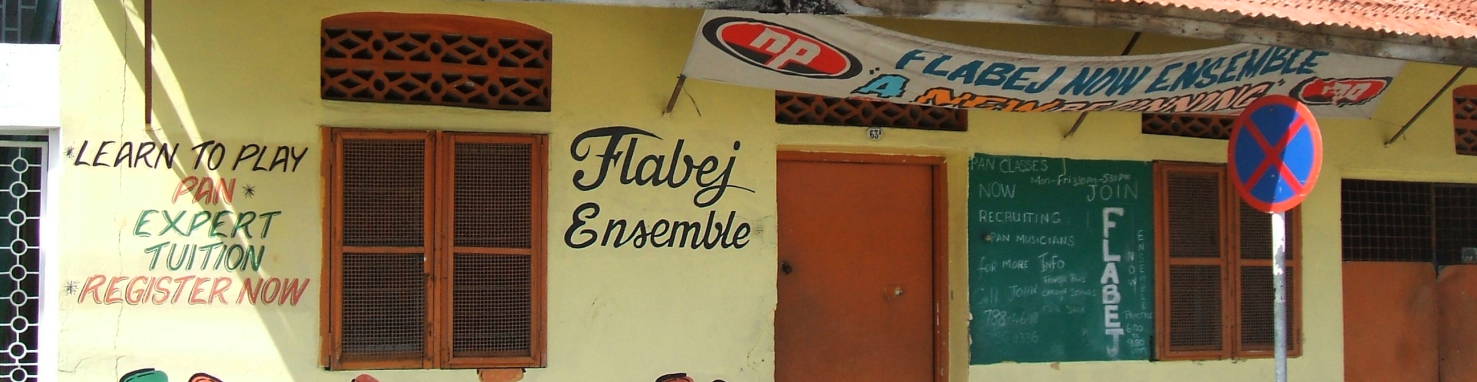
A music school in Trinidad offering lessons in the steel pan drum.

There is kaiso, which is the Old-Skool traditionalists' word for what pretenders like Harry Belafonte call "calypso". And soca, sort of modern dance-kaiso. And reggae. And lots of steel pan.

Real pan is not one steel drum as a novelty addition to a band, it's an entire band made up of steel pan drums in a wide range of sizes. Larger pan bands include the engine room, manned by players with a sense of rhythm if not tune, beating out percussion on all sorts of scrap metal and car parts.

Many people in Trinidad and Tobago claim that the steel pan is the only acoustic musical instrument invented in the 20th century.

This is a place where you can learn to play the pan! Below is some real kaiso and soca and pan music.

Poster for music in Trinidad: 'Crazy Wax Superblue CD Launch and Party, Mas Camp, Saturday 27 January.'
 

Notices about music line the street as Carnival time approaches.

Mas camp is a place that a mas band prepares for Carnival. "Mas" is short for "masquerade". Music, costumes, and more must be prepared before Carnival arrives.

Traditional Mas figures portrayed a set of traditional characters: the Midnight Robber, Police and Thief, Wild Indian, Bat', Jab Molassie, Jab Jab, Red Devil, Blue Devil, and Dame Lorraine.

Poster about music in Trinidad: 'Community Hall Henry Street Pos, Saturday 3rd February: Black Chariot Judah with Nyahbinghi Umba, Shepherd DJ Dov, and Good Behavior, and Jah Bless.'
Poster for music in Trinidad: 'Kaiso As It Was (KAIW International) MAS CAMP: Wednesday 24th January: Trinidad Rio, Funny, Gypsy, The Mechanic, Benjai, Tunapuna Skanty and more...'
 
Typical menu outside a Trinidad restaurant.

This menu is typical for Trinidad — tropical, creole, Indian, all mixed together.

The Alaska Restaurant roti shop in Port-of-Spain, Trinidad.

This is one of the more oddly named businesses: Alaska Restaurant & Bar.

They sell roti, which is a sort of Indian-creole-tropical food.

Roti is a dish that suggests that burritos had been invented in India and then perfected in Trinidad.

The Alaska Restaurant and Bar rolls a mean roti.

A restaurant selling cow heel soup in Trinidad.

Cow heel soup is popular. And as this establishment proclaims, it is The New Centre for Cow Heel Soup.

Notice that next door is the Al-Sultan, a bar with an Arabic name. Welcome to the ethnic mélange of Trinidad.

A recreation club or night club in Trinidad.

Pet supplies and a social club, one-stop shopping!

Having a casual lime!  Hanging out with the locals in a bar in downtown Port-of-Spain, Trinidad.  Two men order drinks at the bar.

Here I am hanging out at a pub downtown for a casual lime with the locals. "Lime" can be used as a noun or verb, to refer to a party, happy hour, relaxing with friends, the end of the day, whatever.

Many pubs enclose the bar in iron grillwork, and with the crossing grill like this one shown above, you have to tip your bottle at about a 45° angle to get it out from behind the bars.

In town for a casual lime.  The exterior of a local bar in Trinidad.
Having a casual lime in Trinidad.  Interior of a local bar in downtown Port-of-Spain, Trinidad.
Having a casual lime with the locals in the Universal Bar in western Port-of-Spain, Trinidad.

Now it's time for a casual lime with the regulars at the Universal Bar in western Port of Spain. It has vertical bars, so you can reach through and lift the bottle out in the vertical position.

And finally, below, some pictures from Bar 52, also in the western part of town.

Hanging out with the locals at Bar 52 in western Port of Spain, Trinidad.  The main bar. Hanging out with the locals at Bar 52 in western Port of Spain, Trinidad.  The guy at the end of the bar.
Hanging out with the locals at Bar 52 in western Port of Spain, Trinidad.  Looking out the door as the traffic passes. Hanging out with the locals at Bar 52 in western Port of Spain, Trinidad.  Some other patrons talk.  The sign says: 'WE ALSO SERVE DRINKS.'

Back to the Travel Recommendations

Click here to inquire about advertising on this or any page on this site.
Home Unix/Linux Networking Cybersecurity Travel Technical Radio Site Map Contact


Use /bin/vi! Manipulate images with ImageMagick! Hosted on OpenBSD
Hosted on Apache This site is viewable with any browser Valid XHTML 1.0! Valid CSS!
© Bob Cromwell Feb 2012. Created with /bin/vi and ImageMagick, hosted on OpenBSD with Apache.    Root password available here, privacy policy here.