Basics of Turkish Grammar
Orthography, Words & Letters
Word order, Turkish characters, vowel harmony and variable vowels, HTML rendering
Let's start our study of the Turkish language by
looking at the Turkish alphabet, vowel harmony,
and word order.
Turkish uses the Latin alphabet used by western European
languages, but with a number of diacritical marks
(or "accents" to us non-linguists).
For example,
Ç
and
Ş,
pronounced as in English
church
and
shoe,
respectively.

The Mevlana Shrine in Konya. See my travel pages for many more pictures.
Turkish uses the Latin alphabet, but with a number of characters with diacritical marks.
Turkish uses something called "vowel harmony", in most words the vowels "harmonize", changing so that the vowel sounds and therefore your mouth position and movements are relatively unchanged through the word. It makes the word easier to say if you can figure out how to harmonize the vowels on the fly.
Finally, as a non-Indo-European language, Turkish has some grammatical features that seem unusual to speakers of most of the languages based in Europe.
Word Order
Sentences are generally: Subject object(s) verb, so something like:
| Turkish: | Köpek | suyu | içiyor. |
| English: | (The) dog | (the) water | is drinking. |
| Turkish: | Güç | bunda | kuvvetli. |
| English: | (The) Force | in this one | strong (is). |
The word immediately before the verb is (usually) the most important word in the sentence and conveys the main point. The subject is often left out if it is a personal pronoun, since it can be derived from the verb conjugation.
That's just a very simple statement. See a later page in this series for more details on word order.
Characters
Turkish uses some characters that aren't supported in basic HTML. Hopefully your browser can understand the following, some of which are rendered with Unicode!
| Char | Example | Explanation | HTML | LATEX | |||
| ç | Ç | çarşı | c with cedilla | ç |
Ç |
\c{c} |
\c{C} |
| ğ | Ğ | dağı | g with a "u-shaped hat" | ğ |
Ğ |
\u{g} |
\u{G} |
| İ | İstanbul | Dotted capital I | İ |
\.{I} |
|||
| ı | çarşı | undotted i | ı |
{\i} |
|||
| ö | Ö | görmek | o with an umlaut | ö |
Ö |
\"{o} |
\"{O} |
| ş | Ş | dolmuş | s with cedilla | ş |
Ş |
\c{s} |
\c{S} |
| ü | Ü | gülmek | u with an umlaut | ü |
Ü |
\"{u} |
\"{U} |
Some other characters will sometimes appear with diacritical marks, especially in words Turkish borrowed from Arabic or Persian:
| Char | Example | Explanation | HTML | LATEX |
| â | lâle (tulip) | a with circumflex Pronounced like ya in gâ, kâ, lâ Lengthened otherwise |
â |
\^{a} |
| î | millî (national) | i with circumflex Lengthened, appears in many adjectives borrowed from Arabic |
î |
\^{\i} |
| û | sükût (silence) | u with circumflex Lengthened |
û |
\^{u} |
Note that your choice of browser may limit the accuracy of what is displayed on the screen or printed. Mozilla Firefox and KDE Konqueror display and print these characters fine.
Vowel harmony
Turkish vowels are said to be of two classes, front and back. But there is also the distinction of open versus close(d), and round versus unround. They can be arranged into a cube, as shown here.
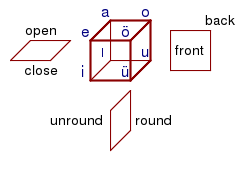
Front: e, i, ö, ü
Back: a, ı, o, u
Open: a, e, o, ö
Close: i, ı, u, ü
Round: o, ö;, u, ü
Unround: a, e, ı, i
Variable Vowels and Vowel Harmony
Turkish has vowel harmony, meaning that a word usually has all its vowels in a single class, front vs back, including those in suffixes added to reflect the part of speech.
Elementary Turkish uses the notation V2 to indicate "the variable vowel e/a" which takes one value depending on vowel harmony, and the notation V4 to indicate "the four-variable vowel shown in the following table". More reasonably, Teach Yourself Turkish calls the first "e-type" and the second "i-type". Note the locations of V2/e-type and V4/i-type in the vowel cube. V2/e-type on the upper-left edge, V4/i-type on the bottom face.
There are three rules of vowel harmony:
1. Back vowels are followed by back vowels, front vowels are followed by front vowels. Do not cross the back/front boundary.
2. Unrounded vowels are followed by unrounded vowels.
3. A rounded vowel may be followed by a mix of rounded closed and unrounded open vowels.
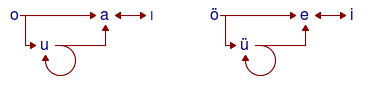
So:
- a or ı may be followed by a or ı
- o or u may be followed by u or a
- e or i may be followed by e or i
- ö or ü may be followed by ü or e
Amazon 0198700369
Amazon 0486250644
Applying Variable Vowels
A word may not necessarily be internally consistent regarding vowel harmony — it may mix front and back vowels. For example, that word you learn early while riding Turkish buses and wondering what is advertised by so many signs along the highway: sigorta, or insurance. Or kitap, or book. However, much of Turkish grammar is formed by adding suffixes, and these suffixes usually follow vowel harmony with the preceding vowel (there are a few exceptions, suffixes of fixed form not following vowel harmony).
For example, the sign found in sleeper compartments of
overnight trains announcing the bed linen charge:
Sayın yolcularımız:
Ekspreslerimizde her gece için alınacak ...
Dear passengers: in our express trains
every night there will be purchased ...
| yol | road | ekspres | express train | |
| yolcu | road-dealer, or really passenger | |||
| yolcular | passengers | ekspresler | express trains | |
| yolcularımız | our passengers | ekspreslerimiz | our express trains | |
| ekspreslerimizde | in our express trains |
Variable Consonants (section 5.2, pg 26)
Some consonants vary depending on whether a voiced or unvoiced consonant is needed. Voiced consonants follow other voiced consonants or vowels, unvoiced consonants follow unvoiced consonants (ç, f, h, k, p, s, ş, t). The pairs are t/d, p/b, and ç/c.
Also, a final k "softens" to ğ when a vowel is suffixed — köpek (dog) becomes köpeği when it is the direct object.
However, see the next section for some exceptions and irregularities.
Optional Letters
Some letters are optional, vowel or consonant buffers between the existing stem so far and the next suffix.
Other Morphological Issues
See the section on morphological changes at the end of the following section on nouns, pronouns, adjectives, etc. for details on other character shifts and some exceptions and irregularities.
Pronouns, nouns, possession, adjectives, adverbs, and conjunctions come next