
Getting to China, and the Languages
Getting There and Getting Around
I've been to Hong Kong two times to teach one-week courses in networking protocols and information security. The first course was on TCP/IP networking for a major U.S. telecommunications firm. The second course was a public Introduction to Cybersecurity course. In both cases I extended the trip to look around a little, going as far as Guangzhou. On the first trip I also visited Macau. On the second trip I went to Guangzhou for a day before continuing by overnight train to Guilin and then a minibus to Yangshou. This is a composite of the experiences and pictures.
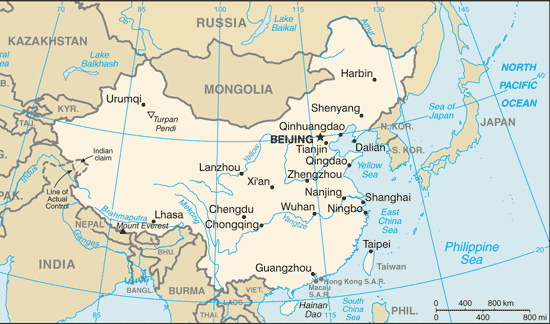
Hong Kong is an excruciating 16-hour flight from Chicago. An only slightly less tiring way of getting there is a flight that stops in Narita (Tokyo) for a couple of hours so you can walk around and get the blood flowing again. Literally.
The routing for the direct flight from Chicago to Hong Kong took us over Winnipeg, Yellowknife, Prudhoe Bay, and out over the Arctic Ocean. Then south over far eastern Siberia, over the Trans-Siberian Railway and then the Amur River, over Manchuria. Then south to Hong Kong, passing close to Hong Kong.
Strong headwinds had slowed us and consumed more fuel, so we had to set down in Beijing to refuel. The air was a murky yellow-grey from all the coal used for heating, the enormous iron works upwind of the city, and all the other industry. Once we were on the ground, ATC mentioned that some of their radar was down and so departure was limited to one aircraft every ten minutes, and we would be #13. Eventually we reached Hong Kong, about three and a half hours behind schedule.
On the second trip I flew on Northwest, formerly Northwest Orient and since absorbed by Delta. We flew from Detroit to Tokyo–Narita, spent a two-hour layover walking around that airport, then on to Hong Kong.
From Hong Kong it's a short train ride to Guangzhou.
From Guangzhou, it's an overnight train to Guilin and then a minibus about 90 minutes south to Yangshuo and the fantastic scenery of Guangxi Province.
I also took a day trip to Macao, another outpost remaining from European colonialism in East Asia. That's a fast ferry ride away from Hong Kong.
Language
Before jumping in, what language do the locals speak? Multiple languages, actually. Saying that people in China speak "Chinese" is like saying that people in Europe speak "European". To start, what's the name of the place? Well, that depends....
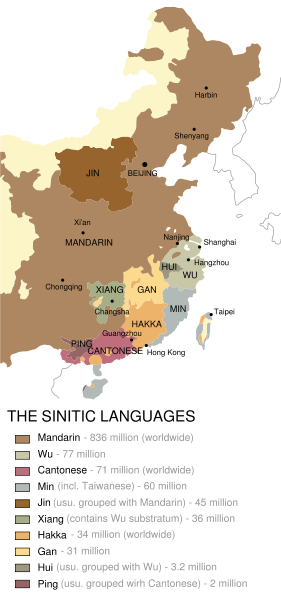
Map of Sinitic langauges or dialects.
Guangzhou is generally pronounced as "guan-zho", with "guan" rhyming with "swan" and "zho" as a voiced "show".
The place used to be called and spelled Canton in the west — the city of Canton was the main city of the province of Canton. Now the city is spelled "Guangzhou" and the district is spelled "Guangdong".
Some of this has to do with the large differences between Mandarin, Cantonese, Hakka, Min, and other Sinitic languages, which aren't mutually intelligible. Part has to do with the difficulties of Romanizing any one Chinese language. That is, attempting to represent a Chinese language in Roman characters. All the Romanization schemes ignore the system of tones, of which there are four in Mandarin and six (or nine, depending on who you ask) in Cantonese. The Pinyin system, currently in favor, includes the brilliant idea that while some letter combinations could used for obvious purposes, like "zh" and "sh", the most useful way to represent the sound of "ch" is the letter "q".
All this is further complicated by the fact that there are no phonetics encoded into the symbols. The symbols represent a concept but have nothing to do with sound.
If someone can read Chinese writing, at least the different dialects map the same meanings onto the symbols. However, the sounds vary widely between dialects. An educated Mandarin speaker could communicate with an educated Cantonese speaker if they wrote everything down using symbols they both knew. Oh, and there are several ways of drawing the same sign, from a very elaborate old-time fashion to a relatively simpler new fashion (which was imposed by the government and hasn't completely caught on).
There aren't really symbols for numbers, Chinese text usually uses the western style of Arabic numerals. There are symbols used for the digits, but they don't really mean the numbers themselves — they are words culturally associated with the number for no apparent reason. This leads to the Hong Kong craze about auspicious and inauspicious numbers, where people pay tens of thousands of dollars to get (or avoid) particular license plate or telephone numbers. Sometimes westerners get really good deals on apartments because they're willing to live in apartment number "death-death-pain" or some such. All of it is enough to make Arabic look simple.
The only Chinese I know are a few words of Mandarin, or at least what I imagine is Mandarin and might be just barely intelligible to an actual Mandarin speaker. A friend in grad school taught me how to say:
- Hello comrade!
- I want that, comrade.
- Thank you, comrade.
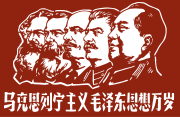
Apparently almost no one in China calls each other "comrade" any more. It's seen as being backward and downright Maoist, a somewhat embarrassing reminder of the Cultural Revolution and other self-destructive collectivist nonsense.
That, of course, just encouraged me to use it as much as possible.
However, be very careful — the Wikipedia article for the word tongzhi says: In recent years, however, this meaning of the term has fallen out of common usage, except within Communist Party discourse and among people of older generations. It remains in use in a formal context among political parties in both mainland China and Taiwan. In the Communist Party of China, the labeling of a person as a "comrade" is especially significant for a person who has been denounced or demoted, because it indicates that the party has not completely rejected the person as "one of its own".
So far, so good. But then it goes on to say that tongzhi is increasingly being misappropriated by the Chinese homosexual and bisexual community as a term for a member of the "sexual minorities", much like the fate of the word "gay" in English.
If I could apply one of my Three Sentences, I would follow it with jingoistic Soviet-era Russian explaining that what I really wanted was a proletarian cup of hot tea or a train ticket in Revolutionary Class ("Just like Lenin's train to the Helsinki Station in Petrograd!") or whatever.
I've read that Chinese grammar is relatively simple. Verbs aren't conjugated. Nouns, pronouns, and adjectives aren't inflected or declined for number, gender, or case. That's the good news, you can just string words together: "Newspaper, comrade, want, no want?" The bad news is the extreme complexity of the writing system.