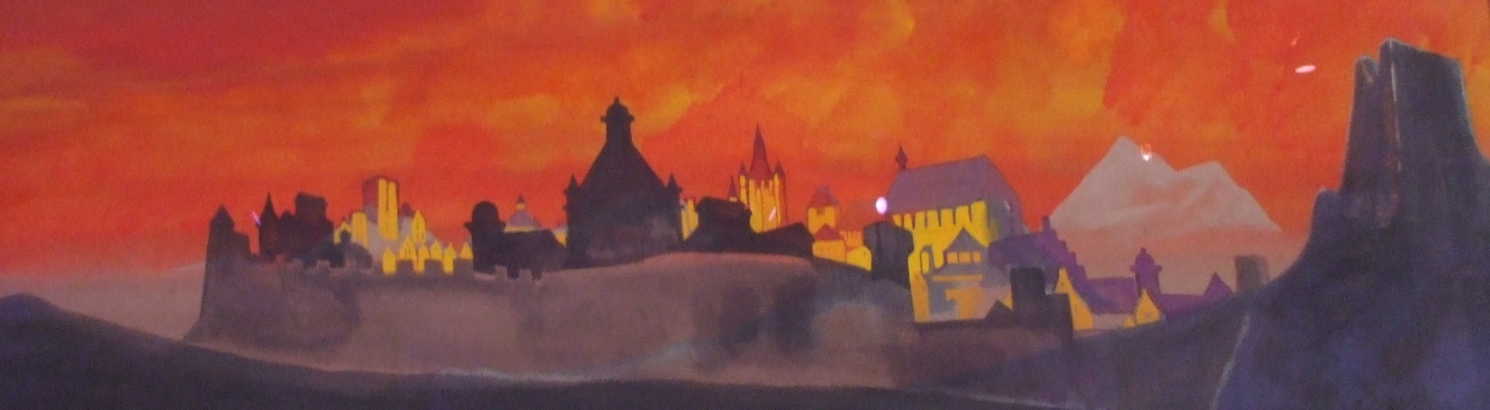
H.P. Lovecraft and Nicholas Roerich in New York
H.P. Lovecraft in Brooklyn
Library of Lovecraft's writingThe classic horror writer H.P. Lovecraft is usually associated with New England, specifically with Rhode Island, but he did live for a while in Brooklyn, New York, setting some of his stories there. His long story "The Horror at Red Hook" is his most prominent New York work. Today you can see where Lovecraft lived in Brooklyn, and on the Upper West Side of Manhattan you can visit the museum of the Russian mystic artist Nicholas Roerich. Lovecraft knew and admired Roerich, who went on to have quite a bit of influence over one of Franklin Roosevelt's Vice Presidents.
Voluminous: The Letters of H.P. LovecraftHoward Phillips Lovecraft was born in 1890 in Providence, Rhode Island. In 1893, his father, a traveling salesman of jewelry and precious metals, became acutely psychotic in a Chicago hotel room while on a business trip. He was brought back to Providence's Butler Hospital, where he remained until he died in 1898.
Have you noticed the nihilism of the Cthulhu Mythos?
The cause seems to have been syphillis leading to "acute paresis of the insane", and Lovecraft's mother was given tincture of arsenic as that era's standard preventative medicine for syphillis. However, Lovecraft always maintained that his father had died in a state of paralysis brought on by "over-exhaustion" caused by an overload of work.
Lovecraft was raised by his mother, Sarah Susan Phillips-Lovecraft; his two aunts, Lillian Delora Phillips and Annie Emeline Phillips; and his maternal grandfather, Whipple Van Buren Phillips, in what seems to have been a deeply weird household.
He was frequently ill as a child, although some was certainly psychosomatic, and he seems to have suffered from night terrors, a fairly rare parasomnia disorder.
Lovecraft believed that he was assaulted by horrific "night gaunts". They were the subject of his poem by that name, in which they were faceless devil-like creatures, and much of his later work is thought to have been inspired by these terrors.
His grandfather died in 1904, leaving the family nearly destitute and leading Lovecraft to consider suicide. In 1908 he claimed to have suffered what he later described as a "nervous breakdown". This led to his never receiving a high school diploma, although he maintained for most of his life that he had.
He lived in a near-hermit lifestyle from 1908 through 1913, with little contact with anyone beyond his mother. But 1913 was the year he wrote a letter to the editor of the pulp magazine Argosy, spurring a debate in the letters column that caught the attention of the president of the United Amateur Press Association. Lovecraft was invited to join them in 1914, invigorating him and leading to his writing and submission a large number of poems and essays.
In 1917 Lovecraft returned to fiction at the suggestion of his correspondents, writing "The Tomb" and "Dagon", the second of which was his first published work. He also began a voluminous correspondence and exchanged many letters with Robert Bloch, Clark Ashton Smith, and Robert E. Howard.
His mother was committed to Butler Hospital in 1919 after suffering from depression and "hysteria" for several years. This was the same hospital where her husband had been committed and died. She died there in 1921, due to complications of gall bladder surgery.
Amazon 0440506603

Amazon 0871404532
One unfortunate aspect of H.P. Lovecraft is his racism, with his frequent ugly remarks against the wide variety of non-Anglo-Saxon races and cultures appearing in his works.
Lovecraft was narrower than your run-of-the-mill White Supremicist. Unlike, say, the American politician Strom Thurmond or his apologist Trent Lott, for whom being Western European would have been "white enough", Lovecraft felt that people of English descent were better than all others. A Paler Shade of White, you see. Some have theorized that Lovecraft was disillusioned and threatened by the United Kingdom's loss of power, failure to dominate the conflicts of the Boer War and World War I, and decreasing control over India through the 1920s. So were a lot of other people, but they didn't all become foaming racists.
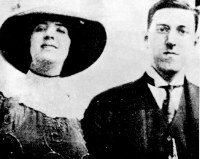
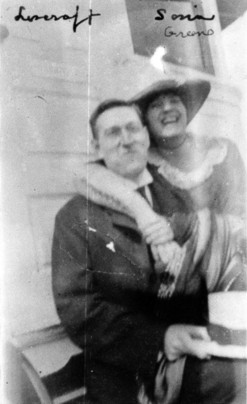
But then, just a few weeks after his mother's death, Lovecraft attended an amateur journalist convention in Boston and met Sonia Greene.
Sonia Greene was seven years older than Lovecraft and of Ukrainian-Jewish descent. She worked as an executive at the Ferle Heller department store, making $10,000 a year. This was five times the average income for an entire family at the time. This allowed her to have a nice apartment in Brooklyn where she organized literary gatherings. Lovecraft began to visit her in New York in 1922, describing the visits' "revivifying" effect.
Sonia was born in 1883 in northern Ukraine in the Russian Empire, either in Ichnia (Ічня) or Konotop (Конотоп). Her background isn't well known — her parents were Simyon and Racille (Haft) Shafirkin, but we don't know if she was recorded as Sonia Haft Shafirkin or Sonia Shafirkin Haft. Her father died when she was a child. Her mother emigrated to the U.S. and left Sonia and a brother at a school in Liverpool, in England.
Sonia joined her mother in America when she was 9, in 1892, and when she was 16 she married Samuel Greene, a Russian. Samuel may have originally been named Samuel Seckendorff. He was described as "a man of brutal character" and he died, apparently by suicide, in 1916.
Sonia became a hat maker and seller at a department store and became independent and of middle class, very unusual for a woman at that time. Her income allowed her to support several amateur publications and travel to conventions of amateur writers. She and Lovecraft met at one of these conventions in Boston in 1921.
Lovecraft, the raging racist, had fallen in love with a Ukrainian Jew. They married in 1924 and Howard moved into Sonia's apartment in Brooklyn.
Sonia soon left the department store and opened her own hat store on Fifth Avenue. She seemed to be quite able to support both her and her impractical literary husband. Her being a tradeswoman may have upset Lovecraft's crotchety aunts. Although I imagine that Sonia's Ukrainian Jewish background probably bothered them much more. Howard had to get his racism from somewhere...
Lovecraft was enthralled with New York at first, but the couple, meaning Sonia, soon came into financial difficulty. Sonia lost her hat shop and Howard couldn't find work to support both of them. Actually he couldn't find work at all.
Sonia had psychological problems from the stress, and checked into a country rest home in New Jersey for a while. She then moved to Cleveland for employment and Lovecraft was left living by himself in Brooklyn.
He lived in an apartment at 169 Clinton Street, on the southeast corner of Clinton and State from the first of 1925 through April of 1926. He had failed to provide for his wife, and was nearly failing to provide for his own rather austere bachelor existence. Meanwhile he was living within an industrious immigrant population. This did not sit well with his concept of himself as a privileged Anglo-Saxon, in the narrowest sense of that term.
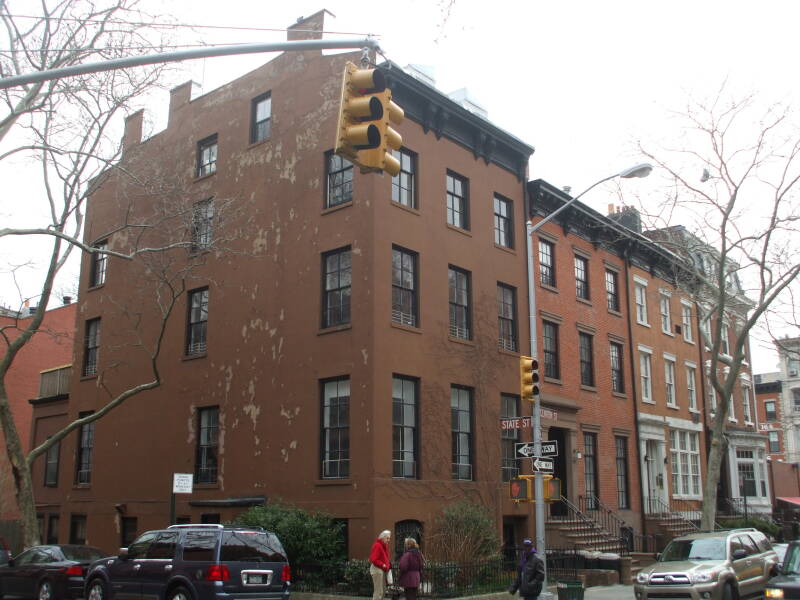
H.P. Lovecraft's home at 169 Clinton Street in Brooklyn, New York.
His long story "The Horror at Red Hook" may be an embodiment of his racism turning to fear. Red Hook is a district of Brooklyn just south of where he lived, close enough that his home at the time might be loosely described as extreme northern Red Hook.
In "Lovecraft at the Automat" in the New England Review, [vol 29, no 1, 2008, pp 137-150], J. M. Tyree writes:
Before leaving New York, however, Lovecraft relocated to a one-room apartment at 169 Clinton Street in Brooklyn Heights (his rent there seems to have been paid by his aunt Annie Gamwell). In that neighborhood, he was to spend the most miserable period of his life, in close proximity to the immigrant lower depths of Red Hook, cultivating hysterical prejudices that were doubtless exacerbated by Lovecraft's tendency toward mental illness and what must have seemed like the inexplicable unfairness of his sudden misfortune. At Clinton Street, the landlady refused to heat the apartment properly, magnifying out of proportion Lovecraft's longstanding physical terror of cold. His bed was a fold-out couch that Lovecraft never folded out, unless Sonia was visiting. Lacking a proper stove, he resorted to the unsavory canned food of the era and cooked A&P spaghetti over a Sterno. He also frequented the city's all-night Automats, describing to Lillian how the system worked in a letter of November 4-5, 1924. In another letter written the following spring, on April 11, 1925, he laid out with mock bravado the details of an eight-cent homemade meal involving bread, cheese, and Heinz beans. May 1925, probably the author's low point, saw theives break into the apartment to steal Lovecraft's suits and a friend's radio equipment.
Let's visit Lovecraft's home in Brooklyn!
You could get there easily enough on foot from Lower Manhattan by walking across the Brooklyn Bridge. Or, take either the 2/3 or the 4/5 MTA line to their Borough Hall station. They're at the south end of the park area shown on this map. Clinton runs roughly north-south just a block west of both subway stations, State is the cross street just four blocks south from there. Notice that Red Hook is just several blocks further south.
As for Lovecraft's racism-driven depression, let's look at some passages from the semi-autobiographical short story "He". His narrator says:
My coming to New York had been a mistake; for whereas I had looked for poignant wonder and inspiration in the teeming labyrinths of ancient streets that twist endlessly from forgotten courts and squares and waterfronts to courts and squares and waterfronts equally forgotten, and in the Cyclopean modern towers and pinnacles that rise blackly Babylonian under waning moons, I had found instead only a sense of horror and oppression which threatened to master, paralyze, and annihilate me.
And:
Coming for the first time upon the town, I had seen it in
the sunset from a bridge, majestic above its waters,
its incredible peaks and pyramids rising flowerlike and
delicate from pools of violet mist to play with the
flaming clouds and the first stars of evening.
Then it had lighted up window by window above the shimmering
tides where lanterns nodded and glided and deep horns bayed
weird harmonies, and had itself become a starry firmament
of dream, redolent of faery music, and one with the marvels
of Carcassonne and Samarcand and El Dorado and all glorious
and half-fabulous cities.
Shortly afterward I was taken through those antique ways so
dear to my fancy-narrow, curving alleys and passages where
rows of red Georgian brick blinked with small-paned dormers
above pillared doorways that had looked on gilded sedans and
paneled coaches — and in the first flush of realization of
these long-wished things I thought I had indeed achieved such
treasures as would make me in time a poet.
But success and happiness were not to be.
Garish daylight showed only squalor and alienage and the
noxious elephantiasis of climbing, spreading stone where the
moon had hinted of loveliness and elder magic;
and the throngs of people that seethed through the
flume-like streets were squat, swarthy strangers with hardened
faces and narrow eyes, shrewd strangers without dreams and
without kinship to the scenes about them, who could never
mean aught to a blue-eyed man of the old folk,
with the love of fair green lanes and white
New England village steeples in his heart.
And then, glimpsing the real New York:
For full three seconds I could glimpse that pandemoniac sight, and in those seconds I saw a vista which will ever afterward torment me in dreams. I saw the heavens verminous with strange flying things, and beneath them a hellish black city of giant stone terraces with impious pyramids flung savagely to the moon, and devil-lights burning from unnumbered windows. And swarming loathsomely on aerial galleries I saw the yellow, squint-eyed people of that city, robed horribly in orange and red, and dancing insanely to the pounding of fevered kettle-drums, the clatter of obscene crotala, and the maniacal moaning of muted horns whose ceaseless dirges rose and fell undulantly like the wave of an unhallowed ocean of bitumen.
Wow, what a crank!
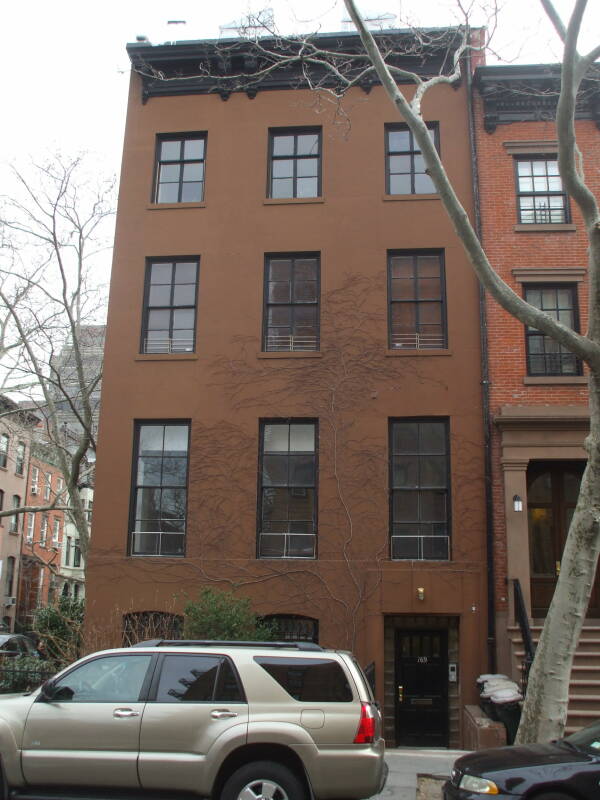
Here are more views of where he lived in 1925–1926.
I checked the array of doorbells. No "Lovecraft", no "Cthulhu", and no invitation to lurk at the threshold.
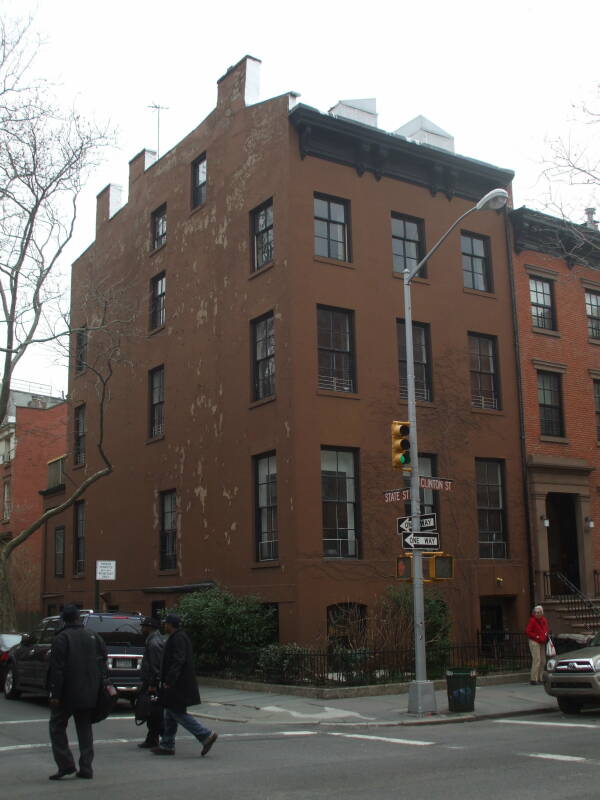
Just north of Lovecraft's home is 133 Clinton Street. A historical marker on that building says:
This house was the former home of the Brooklyn Excelsiors, baseball champions of the United States in 1860. Constructed in 1851, the building was once the Jolly Young Bachelors clubhouse. The Bachelors evolved into the Excelsiors baseball team. One of its pitchers, James Creighton, 307 Henry Street, Brooklyn, is said to have tossed the first curve ball. During the Civil War, the Excelsiors introduced the game to soldiers from various states. Because of its popularity, similar teams were established in other cities. Thus, baseball, as a national sport, can be considered as having its origins in Brooklyn.
Abner Doubleday, U.S. Army officer, did not invent the game of baseball, despite persistent myth. But he was a prominent Theosophist, serving as its American president when its founders moved to India in late 1878.
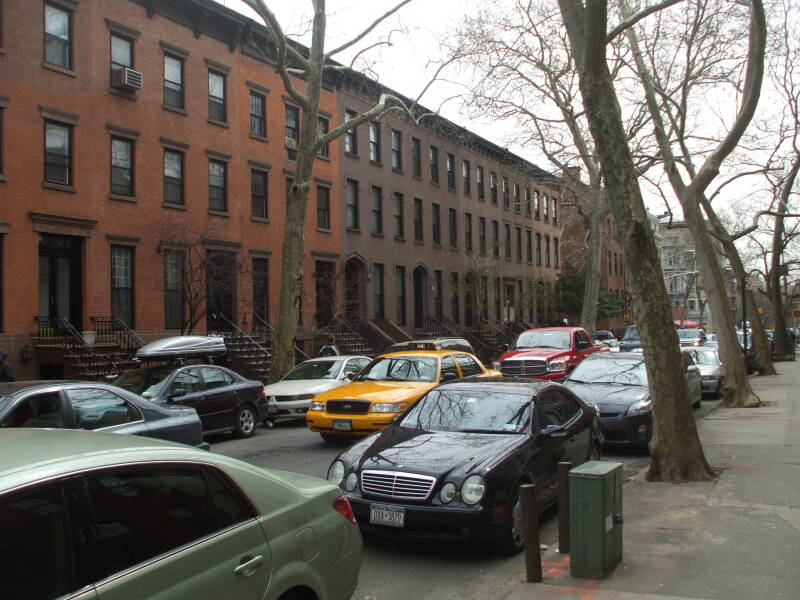
Well, after seeing H.P. Lovecraft's home I was ready to get some lunch.
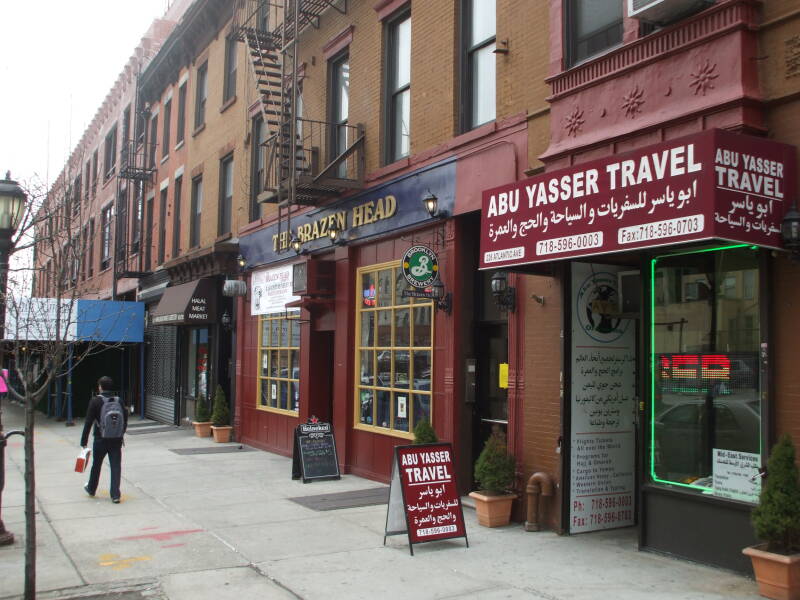
I had seen something about the Brazen Head, a craft brew pub. It's nearby, at 228 Atlantic Avenue.
My plan was to get lunch, maybe something with calimari and accompanied with a Red Hook ESB, thus (a) food with tentacles and (b) a beverage referencing "The Horror at Red Hook".
Here it is, the Brazen Head, at 228 Atlantic Avenue. It's right next to the Arabic-signed Abu Yasser Travel, which just makes it more Lovecraftian!
In "The Horror at Red Hook" he describes the area as:
... a maze of hybrid squalor near the ancient waterfront opposite Governor's Island, with dirty highways climbing the hill from the wharves to that higher ground where the decayed lengths of Clinton and Court Streets lead off toward the Borough Hall. Its houses are mostly of brick, dating from the first quarter to the middle of the nineteenth century, and some of the obscurer alleys and byways have that alluring antique flavor which conventional reading leads us to call 'Dickensian'. The population is a hopeless tangle and enigma: Syrian, Spanish, Italian, and Negro elements impinging upon one another, and fragments of Scandinavian and American belts lying not far distant. It is a babel of sound and filth, and sends out strange cries to answer the lapping oily waves at its grimy piers and the monstrous organ litanies of the harbour whistles.
And, later:
In the teeming rookeries of Parker Place — since renamed — where Suydam had his basement flat, there had grown up a very unusual colony of unclassified slant-eyed folk who used the Arabic alphabet but were eloquently repudiated by the great mass of Syrians in and around Atlantic Avenue.
They were said to practice a ritual which was:
some remnant of Nestorian Christianity tinctured with the Shamanism of Thibet. Most of the people, he conjectured, were of Mongoloid stock, originating somewhere in or near Kurdistan — and Malone could not help recalling that Kurdistan is home of the Yezidis, last survivors of the Persian devil-worshippers. [...] Their square figures and characteristic squinting physiognomies, grotesquely combined with flashy American clothing, appearing more and more numerously among the loafers and noman gangsters of the Borough Hall section.
On I go into the Brazen Head! It's a clean, well-lighted place.
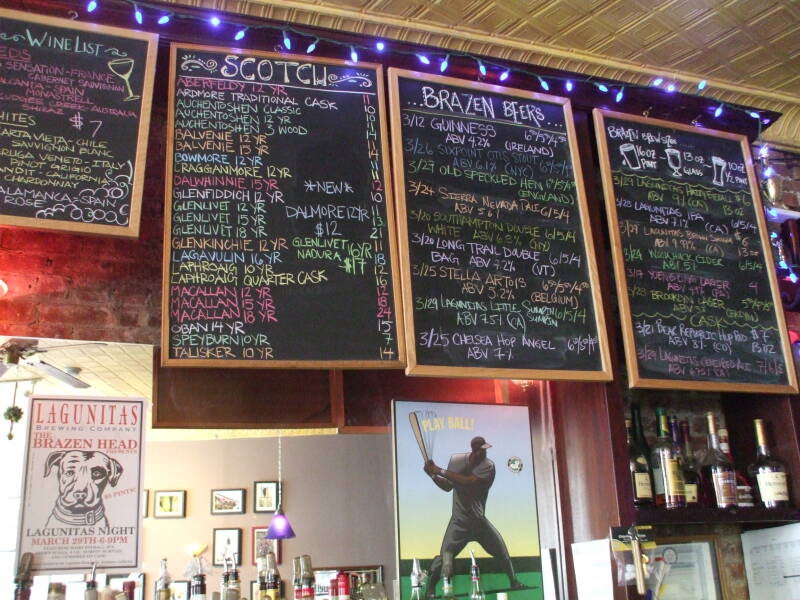
And it is a craft beer sort of place. But no Red Hook products.
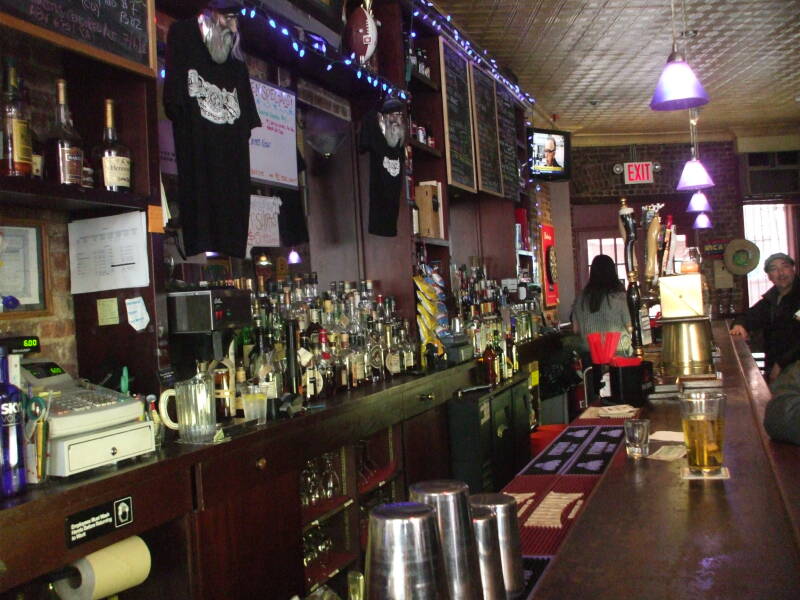
They have a wide range of adult beverages, but nothing by the Red Hook brewery.
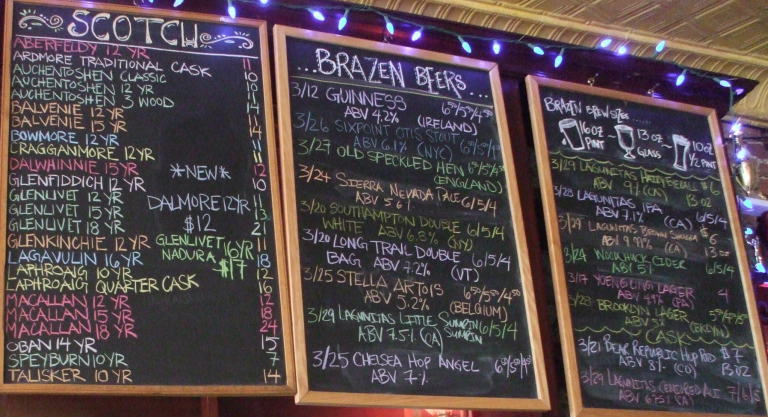
And no kitchen, no food at all. Well, nothing beyond some nice bowls of pretzels.
Just as I gave up on my lunch of tentacles and ESB, HPL gave up on his marriage. After a few years, he and Sonia were still living separately and agreed to an amicable divorce, which was never completed. Lovecraft returned to Providence and moved back in with his elderly aunts in April of 1926. The following decade was his most prolific, in which he produced almost all of his best-known works for the leading pulp magazines of the time. He did come back to visit New York from time to time, visiting friends in 1926, 1928, and around Christmas in 1932, but they were short visits from his home in Providence.
His time in Brooklyn had been productive. In August 1925 he wrote The Horror at Red Hook, the outline of The Call of Cthulhu, and He. In March 1926 he wrote Cool Air, another of his distinctively New York stories.
Cthulhu andGreenland
Lovecraft was relatively unknown while alive. His stories appeared in the relatively prominent pulp magazines such as Weird Tales, often eliciting letters of outrage from regular readers, but not many people knew his name. Later critics have grouped his fiction into three categories:
- Macabre stories (approximately 1905-1920)
- Dream Cycle stories (approximately 1920-1927)
- Cthulhu Mythos stories (approximately 1925-1935)
H.P. Lovecraft died of intestinal cancer in 1937.
Saint Paul's Chapel
H.P. Lovecraft and Sonia Greene were married on Monday, 3 March 1924, at Saint Paul's Chapel at Broadway and Vesey Street in lower Manhattan. The location appealed to Lovecraft as the church was then, and still is, the oldest surviving church building in Manhattan, and also the oldest public building in continuous use in New York City.
When it was finished in 1766, Saint Paul's was the tallest building in New York City. Actually the tallest building in the city and its surroundings, as the city at that time was limited to today's Financial District.
The Dutch established Nieuw-Amsterdam as the first European settlement. De Walstraat was the passageway along their northern defensive wall. The English captured the settlement in 1664. In a 1667 treaty the English gave the Dutch a 3-by-1-kilometer island in Indonesia and guaranteed their control of Suriname, in South America. Then again, the legend is that the Dutch had traded a handful of beads for control of Manhattan. Easy come, easy go.
Saint Paul's was built in the 1760s in a field still outside the city. Broadway was a highway leading north. Now One World Trade Center looms over the church.
The church is built in the Georgian style of its era. Boxy proportions, dark mica-schist and brownstone exterior. Its simple interior hall has pale colors, a simple ceiling, and cut glass chandeliers. This was Lovecraft, he wouldn't have cared about the theology, but he appreciated the traditional English design.
The Broadway end, seen below, is actually the east end with the altar. There are entry doors at either corner of the columned portico. There's also an entry at the center of the opposite end, the west end and the rear of the sanctuary, under the steeple.
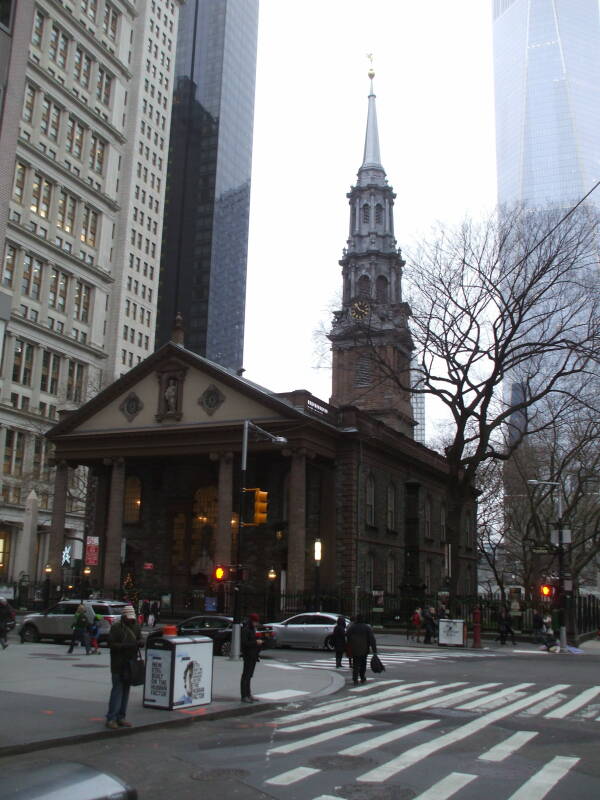
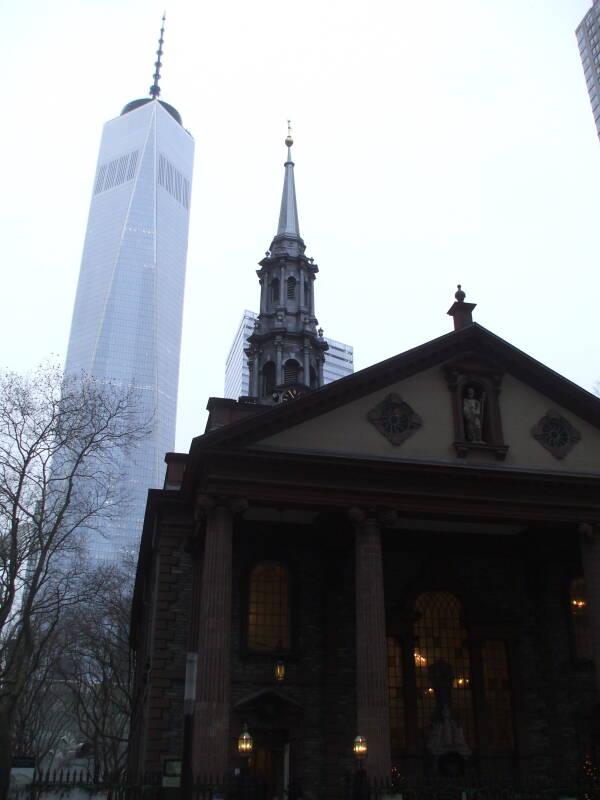
George Washington and members of the U.S. Congress worshiped here on Washington's Inauguration Day on 30 April 1789. They also attended services here for the following two years while the nation's capital was just a few blocks south on Wall Street. Federal Hall, the original national capitol building, sits diagonally across the intersection of Wall Street and Broad Street from the façade of the New York Stock Exchange.
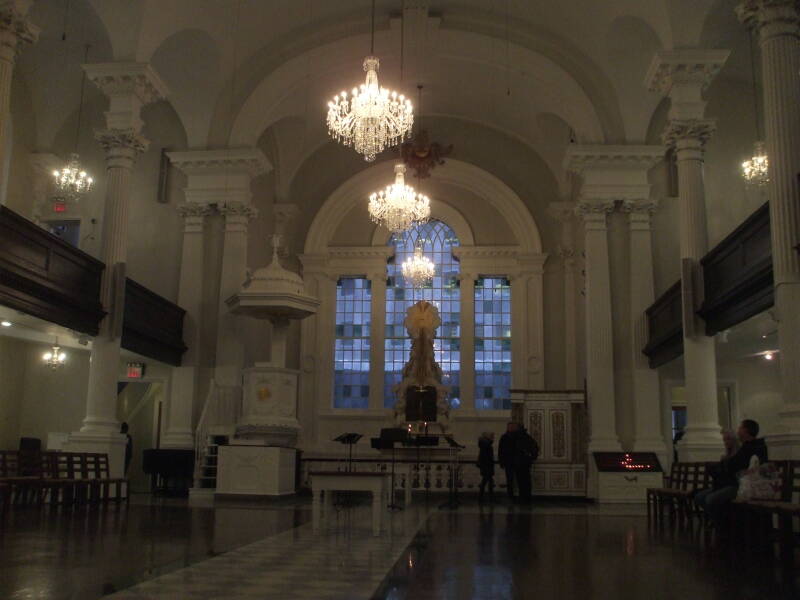
Interior view from the rear toward the altar.
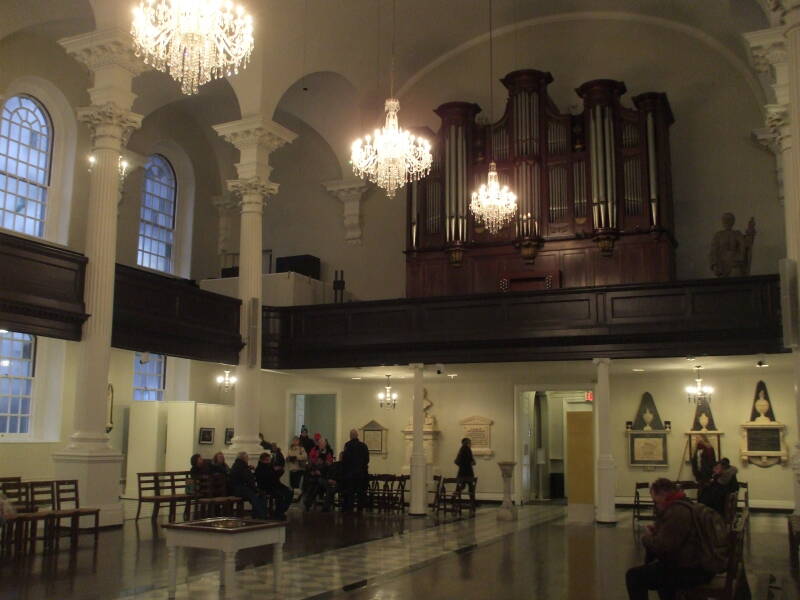
Interior view from the front toward the rear showing the pipe organ.
Sonia Greene's Home in Brooklyn
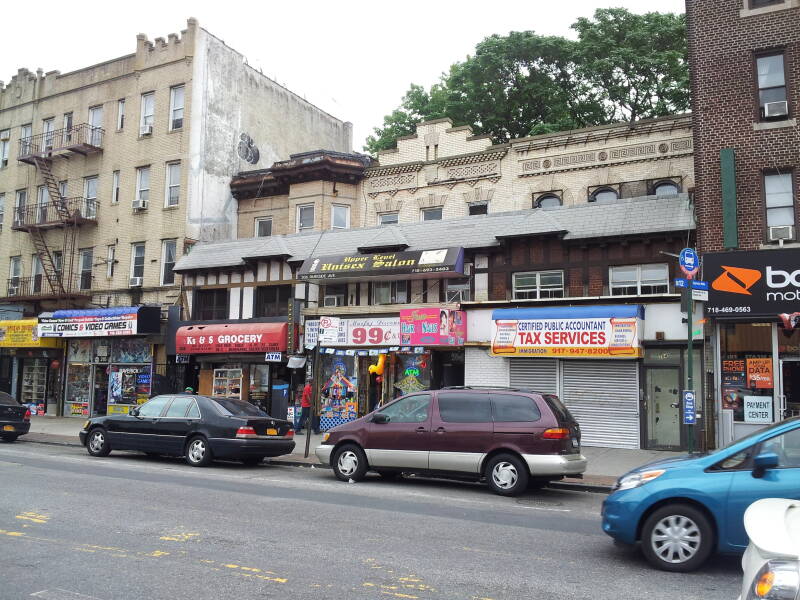
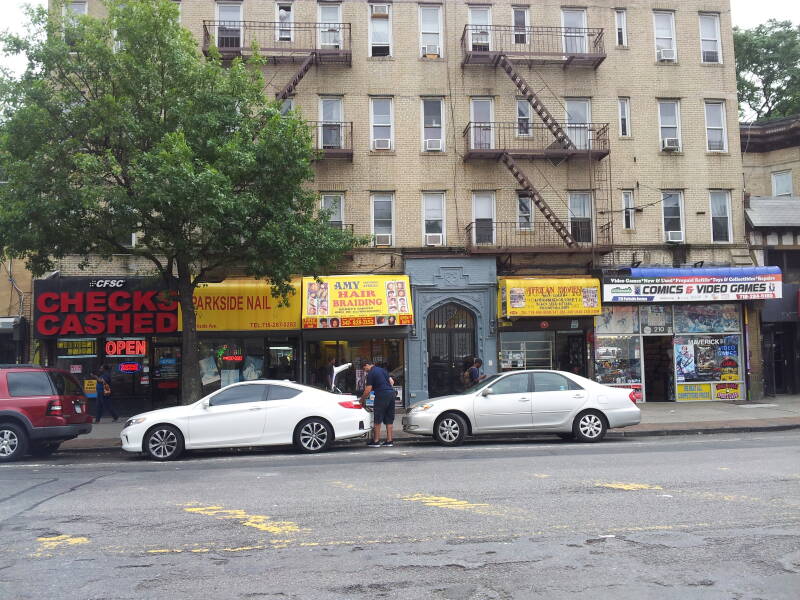
Sonia Greene lived in an apartment building at 259 Parkside Avenue in the Flatbush neighborhood of Brooklyn. Howard had visited her here since 1922, and he moved here from Providence after their marriage in 1924. He lived here from March through the end of December, 1924.
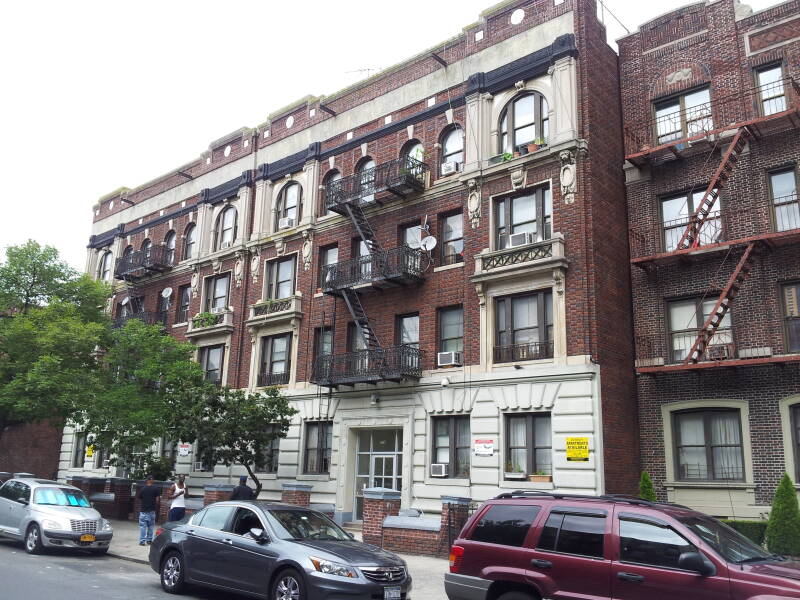
This is just east of the southeast corner of the large Prospect Park. You can get here by taking the Q line to the Parkside Avenue station and walking east across Flatbush Avenue.
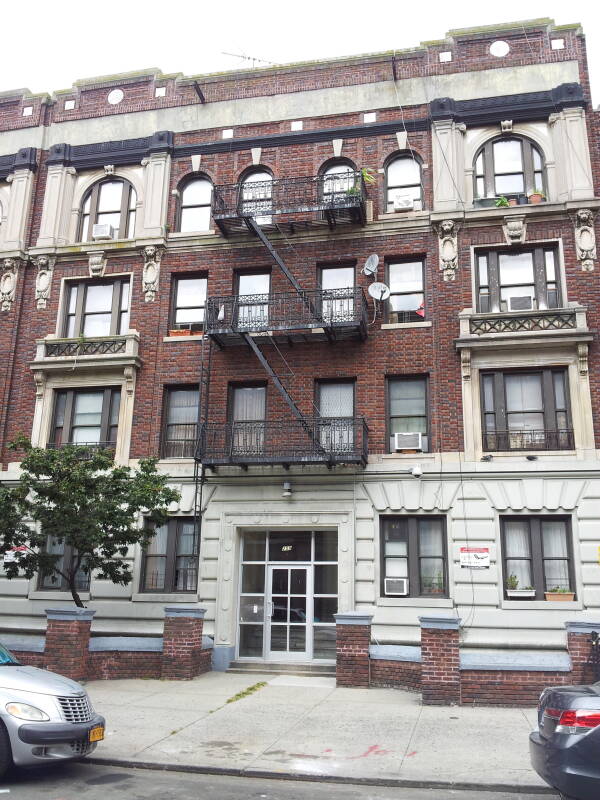
I feel pretty sure that H.P. would be outraged by the ethnic makeup of today's Flatbush.
Lovecraft Bar
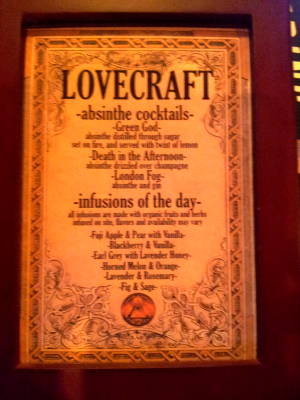
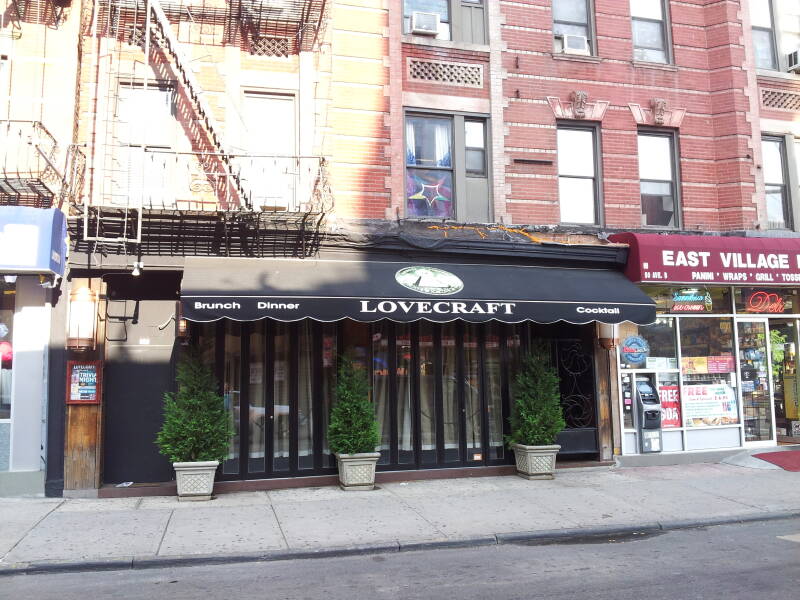
The Lovecraft Bar opened on the Lower East Side in the fall of 2014. It was at 50 Avenue B.
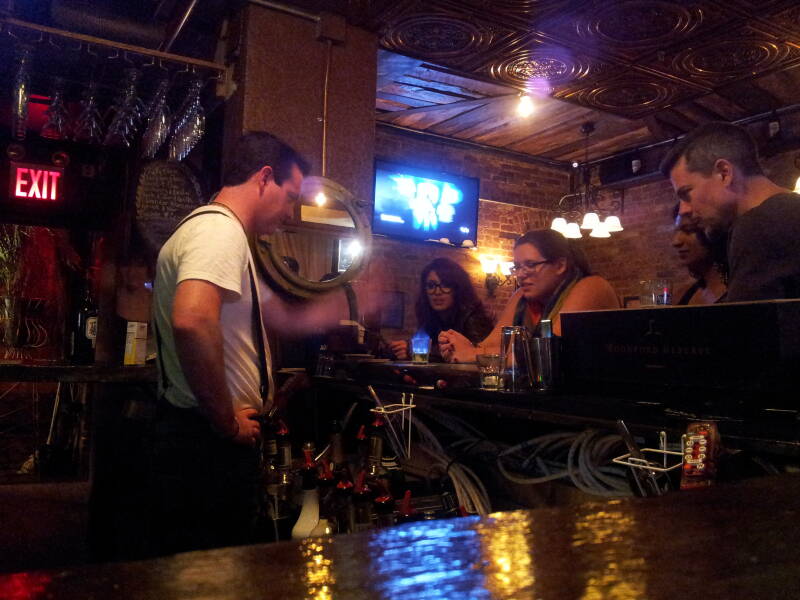
The nicely detailed décor was more steampunk than Lovecraft. The bartender on duty the first time I visited clearly wanted to really be an actor, and his vague notion of Lovecraft was thoroughly confused with Nikola Tesla.
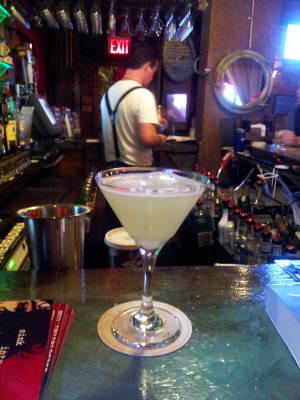
They had some absinthe cocktails and some infusions. This is the London Fog, made with absinthe and gin, none of the silly current trend of lighting the absinthe on fire.
I went back another night and found a bartender who was a Lovecraft enthusiast. He agreed that they needed to serve food, starting with calimari.
But then by early 2018 it had closed.
Roosevelt
in New York
Lovecraft and his circle of friends, calling themselves the Kalem Club, frequented the Double R coffee house at 112 West 44th Street. The Double R was owned by three children of Theodore Roosevelt, Ted, Archie, and Ethel, along with Ethel's husband, Theodore's cousin Philip, and Theodore's nephew Monroe Douglas Robinson. Lovecraft wrote a short poem about the coffee house, "On the Double R Coffee House", it includes:
Of busy hour and bustling crowd
And sparkling brightly mind to mind
Display their inmost dreams aloud.
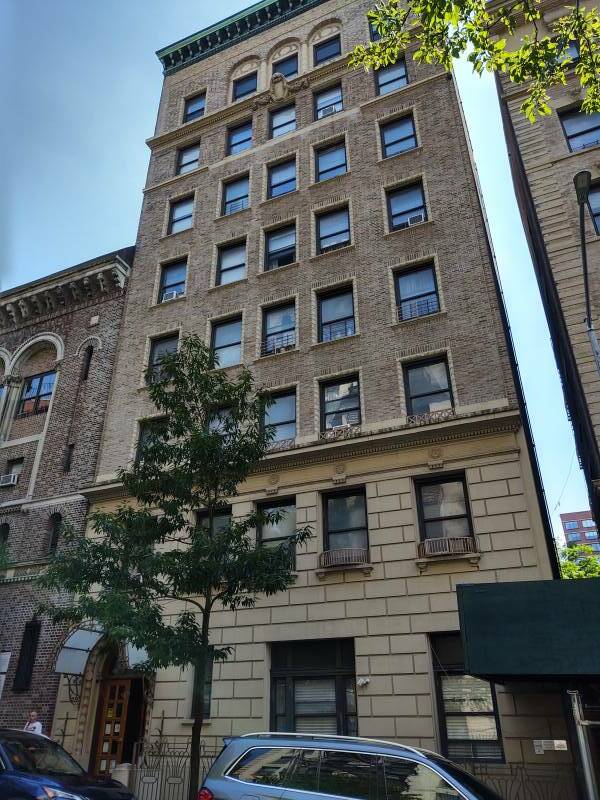
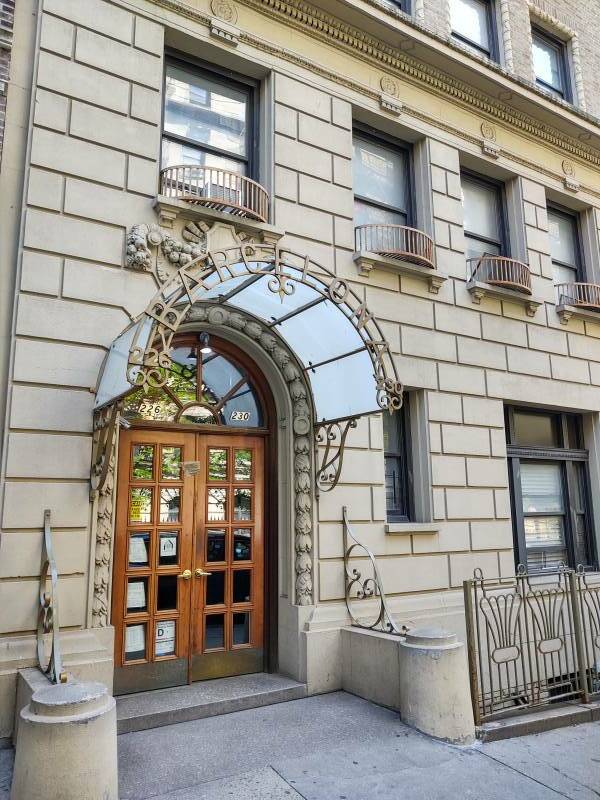
230 West 97th Street
Lovecraft stayed with his friend S. B. Long, Jr., during visits to New York before moving there.1 Long lived here at 230 West 97th Street.
Previously called The Wilmington, the building was completed in 1910. Now it's called The Barcelona.
Nicholas Roerich in Manhattan
H.P. Lovecraft was fascinated by the work of the Russian artist, philosopher, and mystic Nicholas Roerich, who had designed the sets and costumes for the revolutionary ballet Le Sacre de Printemps in Paris in 1913.
Lovecraft mentioned Roerich a number of times in his correspondence. For example:
Merritt has a wide acquaintance among mystical enthusiasts, and is a close friend of old Nicholas Roerich, the Russian painter whose weird Thibetan landscapes I have so long admired.
— to Robert H. Barlow, 13 January 1934
And, more significantly:
Better than the surrealists, though, is good old Nick Roerich, whose joint at Riverside Drive and 103rd Street is one of my shrines in the pest zone. There is something in his handling of perspective and atmosphere which to me suggests other dimensions and alien orders of being — or at least, the gateways leading to such. Those fantastic carven stones in lonely upland deserts — those ominous, almost sentient, lines of jagged pinnacles — and above all, those curious cubical edifices clinging to precipitous slopes and edging upward to forbidden needle-like peaks!
— to James F. Morton, March 1937
He also referenced Roerich's art in his novella At The Mountains Of Madness, as discussed below.
There is now a Nicholas Roerich Museum. It is at 319 West 107th Street, close to the location that Lovecraft describes as "good old Nick Roerich's joint" on 103rd Street. It's open 1400-1700 all days except Mondays.
Here we are looking west down 107th Street. The museum is the one with the Roerich Peace Pact flag, the white flag with a red circle around three red spheres.
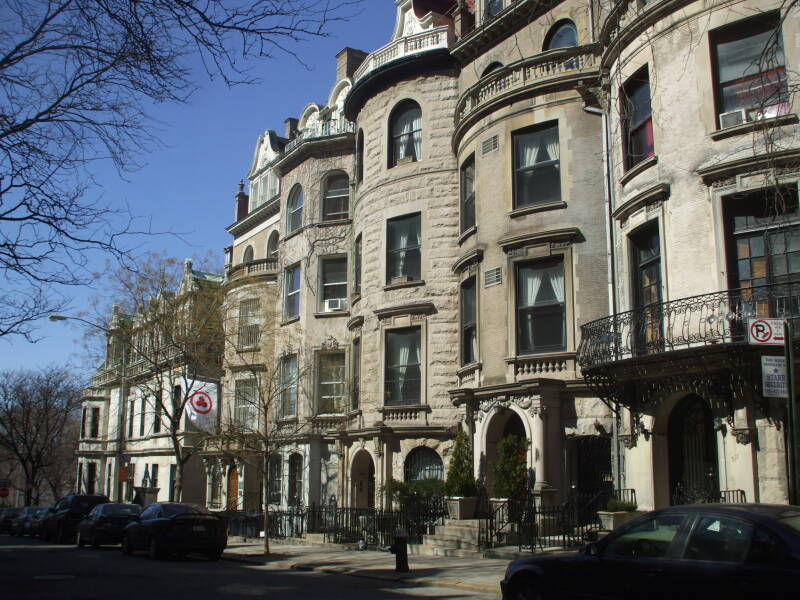
Roerich Museum at 319 West 107th Street, with the red-on-white flag.
The Roerich Museum has a web site, and there is a Wikipedia page about Roerich, They're both good, so far as they go, but exist in a form that invites criticism in phrases such as, well, "so far as they go".
The Wikipedia page in particular strikes me as the result of taking something written in Russian by a dedicated fan and pouring that into a Russian-to-English automated translation process. That sort of breathless adulation usually is immediately tagged for correction in Wikipedia (and see here pretty much everything ever written about the various Star Trek franchise components). I suppose that the subject's obscurity coupled with the resulting stilted prose have combined to let this remain as it is. It has been improved since I first saw it, but it remains odd in places.
Nikolái Konstantínovitch Rérikh, or Николай Константинович Рёрих, was born in Sankt-Peterburg in 1874. That's him in this self-portrait.
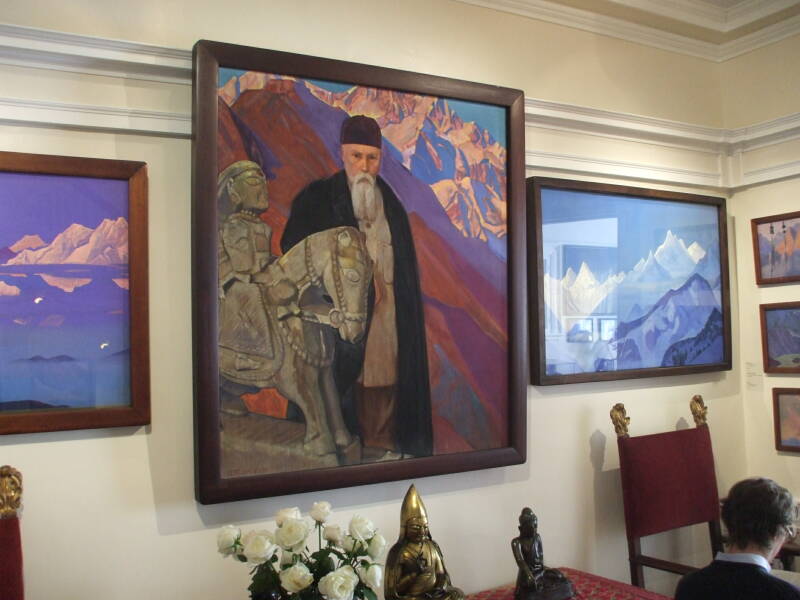
Self-portrait of Николай Константинович Рёрих between some of his mountainscapes.
As for Рёрих, with that curious ё, that's the Russian yo, a letter which is always stressed. Рёрих or Roerich isn't exactly a Russian family name, it was claimed (by Roerich himself) to be "ancient Scandinavian".
One thing led to another, and specifically some sort of lung disease and then a doctor's insistence, and he was living in Sortavala, Finland, on the shore of Lake Ladoga, when the Russian Revolution broke out.
That was it. While he always considered himself a Russian, he was never again able to live in his homeland.
He traveled around the Scandinavian countries in 1919, and in 1920 the Art Institute of Chicago organized an exhibition tour of his art through 30 U.S. cities.
In 1923 he seems to have established himself in India, where he was based for the rest of his life. He seems to have arrived there at the end of an expedition through central Asia, touching in some order Russia (including Moscow), Siberia, Altai, Mongolia, China, Tibet, Sikkim, Kashmir, and Ladakh. Then he continued traveling from 1924 through 1928.
Urusvati, an Institute of Himalayan Studies, was established in the Kullu Valley in the western Himalaya range in 1928. This would have been in the Punjab area of what was then entirely India during the British Raj.
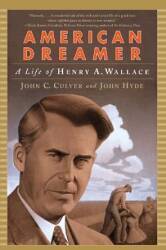
Henry Wallace now makes his appearance.
Wallace was born in Iowa, attended Iowa State College in Ames, and experimented and wrote many academic papers on agricultural theory and practice. For example, his 1915 work in which he devised a corn-hog ratio chart predicting the probable course of agricultural markets. He founded Hi-Bred Corn, which became Pioneer Hi-Bred, which was acquired by the Dupont Corporation in 1999 for approximately $10 billion.
Clearly, Wallace knew his corn.
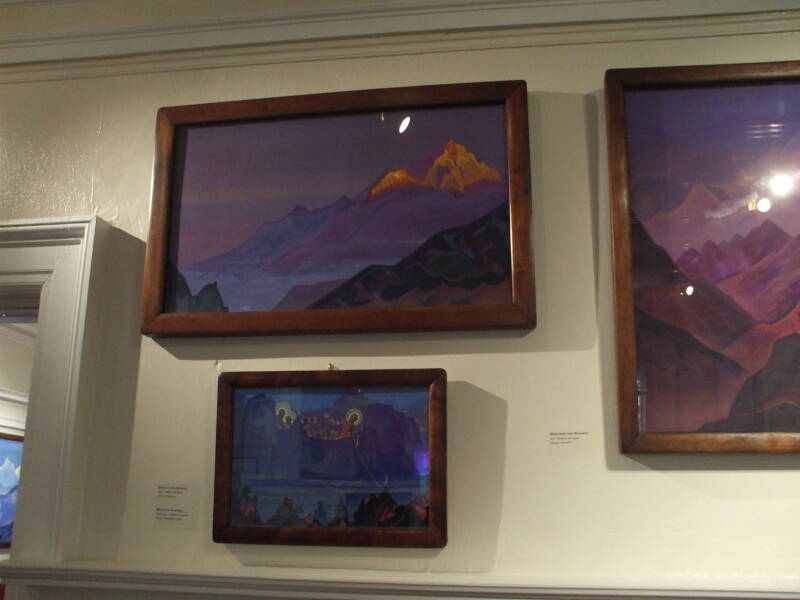
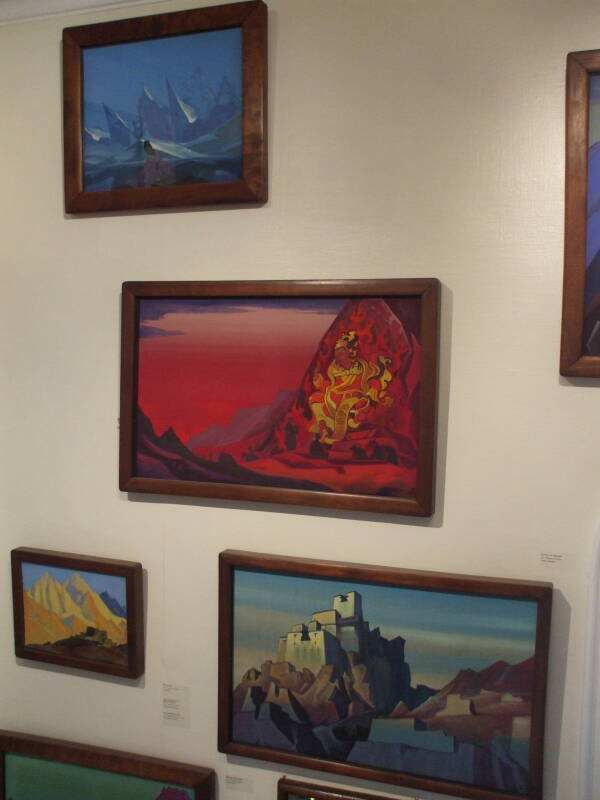
Himalayan mountainscape and Russian mystic artworks.
Wallace was raised as a Presbyterian but left that denomination, spending most of his early life "exploring other religious faiths and traditions". As Arthur Schlesinger, Jr wrote, "Wallace's search for inner light took him to strange prophets....It was in this search that he encountered Nicholas Roerich, a Russian emigre, painter, theosophist."
Wallace was appointed Secretary of Agriculture under Franklin Delano Roosevelt, serving in that office 1933-1940. During that time he first successfully lobbied the U.S. Congress to have Roerich's Banner and Pact of Peace supported, and signed by Roosevelt along with delegates from 22 Latin American countries in 1935. Roerich had set himself up as sort of a one-man Dalai Lama, UNESCO, and Jimmy Carter rolled into one.
Wallace then sent Roerich on an expedition to Central Asia, allegedly to collect drought-resistant grasses to prevent another Dust Bowl. Meanwhile Roerich was really searching for "Northern Shambhalla", essentially the Buddhist "Kingdom of Heaven".
Roosevelt's Vice-President through his first two terms, John Garner, had turned against the President and was planning to run on his own. Wallace replaced Garner on the party's ticket.
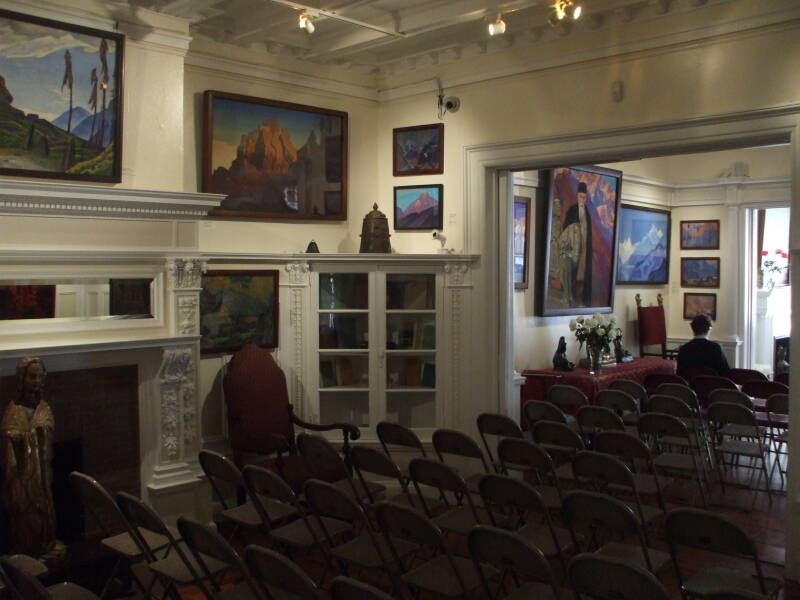
Area for presentations within the Roerich Museum.
During the 1940 election, the Republican party got access to a series of letters that Wallace had written to Roerich in the 1930s. Wallace addressed Roerich as "Guru", and signed all the letters as "G", for "Galahad", a name Roerich had assigned to him. In the letters, Wallace told Roerich that he awaited "the breaking of the new day" when the people of Northern Shambhalla would create an era of peace and plenty.
Amazon 0393322289
The Republicans threatened to reveal the letters and Wallace's "eccentric religious beliefs". The Democrats countered by threatening to reveal Republican Presidential candidate Wendall Wilkie's extramarital affair with the writer Irita Van Doren. Both sides backed down, and Wallace was Vice-President on the winning ticket.
Wallace gave a speech in 1942 which came to be known as "Century of the Common Man", based on a dramatic phrase within it. The speech, and the book of the same name appearing in the following year, were based on Christian references and laid out a positive vision for the Second World War beyond the simple defeat of Nazi Germany and Japan. The speech and book were quite popular, but they earned Wallace enemies among the Democratic leadership, wartime ally Winston Churchill, and business leaders.
Then, in 1944, he started a 25-day journey through the Soviet Union, accompanied by Owen Lattimore.
They started from Alaska and landed at Magadan, where they were met by Sergei Goglidze and Ivan Nikishov, both of them NKVD generals. The NKVD, Народный Комиссариат Внутренних Дел or People's Commissariat for Internal Affairs, was at once both a public and secret police organization directly executing Soviet power, including political repression, during Joseph Stalin's rule.
The NKVD gave the American visitors a fully sanitized tour, taking them to slave labor camps in Magadan and Kolyma while convincing them that all the work was done by volunteers. The travelers were charmed with local entertainment, and left impressed with the "development" of Siberia and the spirit of its "volunteers". Lattimore's film of the trip relates that "a village in Siberia is a forum for open discussion like a town meeting in New England." In an article for National Geographic he described what he saw as a combination of the Hudson's Bay Company and the Tennessee Valley Authority. He said that the inmates were strong and well-fed, and said that camp commandant Ivan Nikishov had "a trained and sensitive interest in art and music and also a deep sense of civic responsibility."
Roosevelt and the Democratic Party decided that they had to get rid of Wallace somehow. A public quarrel between Wallace and some officials of the conservative wing of the party, including Jesse Jones, Secretary of Commerce, led to Roosevelt stripping Wallace of his war agency responsibilities.
The Democratic Party chose Harry S Truman as Roosevelt's running mate for the 1944 election, and Truman took Wallace's place as Vice-President in January 20, 1945. Wallace was moved to Secretary of Commerce, where he served until 1946.
Roosevelt died and was succeeded by Truman on April 12, 1945.
The United States had come within 82 days of having President Henry Wallace.
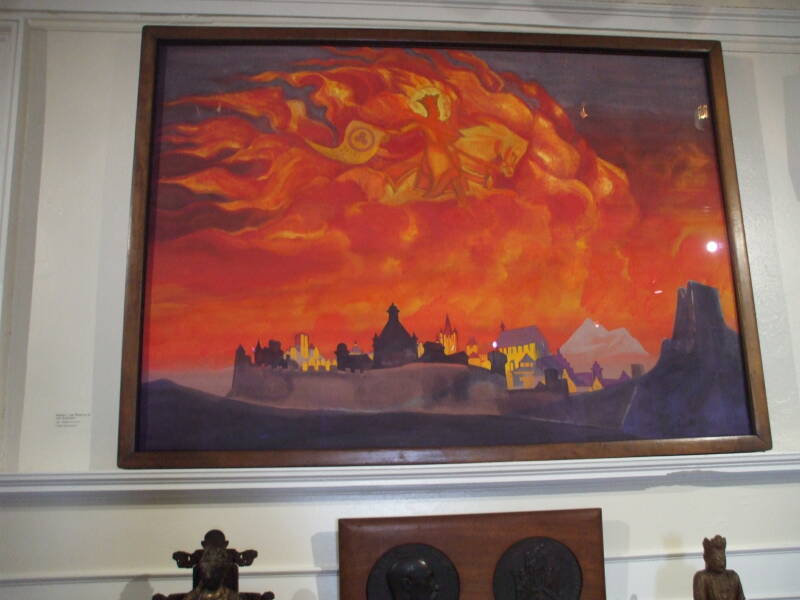
"Sophia — The Wisdom of the Almighty", 1932, tempera on canvas.
Although, given the conspiracy theories about Barack Obama's birth and the G.O.P. doctrine that all U.S. Presidential candidates must believe in an absolutely literal reading of Genesis as a geology textbook, maybe it would have been a good thing to have once had a President who dabbled in Theosophy.
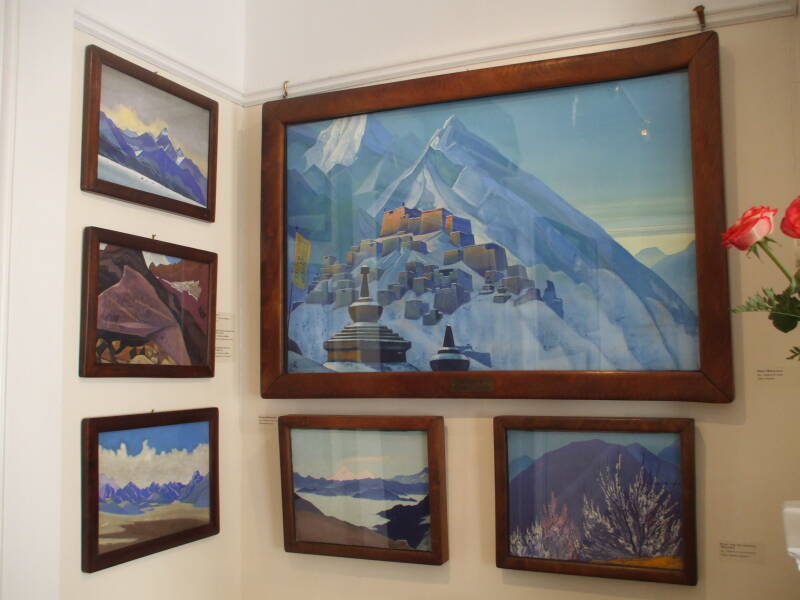
"Tibet, Himalayas", 1933, tempera on canvas.
Anyway, back in the 1920s and 1930s, H.P. Lovecraft liked Roerich's art.
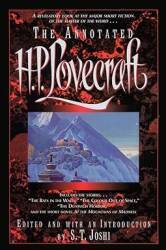
Library of Lovecraft's writingThe painting at top here, Tibet, Himalayas, was used on the cover of Joshi's edition of The Annotated H.P. Lovecraft.
Roerich's art includes Himalayan and Tibetan mountainscapes, Buddhist imagery, and traditional Russian scenes.
Lovecraft referenced Roerich's works six times in his novella At The Mountains Of Madness.
From Chapter One of At The Mountains Of Madness:
The last lap of the voyage was vivid and fancy-stirring. Great barren peaks of mystery loomed up constantly against the west as the low northern sun of noon or the still lower horizon-grazing southern sun of midnight poured its hazy reddish rays over the white snow, bluish ice and water lanes, and black bits of exposed granite slope. Through the desolate summits swept ranging, intermittent gusts of the terrible antarctic wind; whose cadences sometimes held vague suggestions of a wild and half-sentient musical piping, with notes extending over a wide range, and which for some subconscious mnemonic reason seemed to me disquieting and even dimly terrible. Something about the scene reminded me of the strange and disturbing Asian paintings of Nicholas Roerich, and of the still stranger and more disturbing descriptions of the evilly fabled plateau of Leng which occur in the dreaded Necronomicon of the mad Arab Abdul Alhazred. I was rather sorry, later on, that I had ever looked into that monstrous book at the college library.
From Chapter Two of At The Mountains Of Madness:
Though it was technically sleeping-time, not one of us
listeners thought for a moment of retiring.
It must have been a good deal the same at McMurdo Sound,
where the supply cache and the Arkham were also getting the
messages; for Captain Douglas gave out a call congratulating
everybody on the important find, and Sherman, the cache
operator, seconded his sentiments. We were sorry, of course,
about the damaged aeroplane, but hoped it could be easily
mended. Then, at 11 P.M., came another call from Lake:
"Up with Carroll over highest foothills.
Don't dare try really tall peaks in present weather,
but shall later.
Frightful work climbing, and hard going at this altitude,
but worth it.
Great range fairly solid, hence can't get any glimpses beyond.
Main summits exceed Himalayas, and very queer.
Range looks like pre-Cambrian slate, with plain signs of
many other upheaved strata.
Was wrong about volcanism.
Goes farther in either direction than we can see.
Swept clear of snow above about twenty-one thousand feet.
Odd formations on slopes of highest mountains.
Great low square blocks with exactly vertical sides, and
rectangular lines of low, vertical ramparts, like the
old Asian castles clinging to steep mountains in
Roerich's paintings.
Impressive from distance.
Flew close to some, and Carroll thought they were formed
of smaller separate pieces, but that is probably weathering.
Most edges crumbled and rounded off as if exposed to storms
and climate changes for millions of years.
Parts, especially upper parts, seem to be of lighter-colored
rock than any visible strata on slopes proper, hence of
evidently crystalline origin.
Close flying shows many cave-mouths, some unusually regular
in outline, square or semicircular.
You must come and investigate.
Think I saw rampart squarely on top of one peak.
Height seems about thirty thousand to thirty-five thousand feet.
Am up twenty-one thousand, five hundred myself, in devilish,
gnawing cold.
Wind whistles and pipes through passes and in and out
of caves, but no flying danger so far."
From Chapter Three of At The Mountains Of Madness:
It was young Danforth who drew our notice to the curious regularities of the higher mountain skyline — regularities like clinging fragments of perfect cubes, which Lake had mentioned in his messages, and which indeed justified his comparison with the dreamlike suggestions of primordial temple ruins, on cloudy Asian mountaintops so subtly and strangely painted by Roerich. There was indeed something hauntingly Roerich-like about this whole unearthly continent of mountainous mystery. I had felt it in October when we first caught sight of Victoria Land, and I felt it afresh now. I felt, too, another wave of uneasy consciousness of Archaean mythical resemblances; of how disturbingly this lethal realm corresponded to the evilly famed plateau of Leng in the primal writings. Mythologists have placed Leng in Central Asia; but the racial memory of man — or of his predecessors — is long, and it may well be that certain tales have come down from lands and mountains and temples of horror earlier than Asia and earlier than any human world we know. A few daring mystics have hinted at a pre-Pleistocene origin for the fragmentary Pnakotic Manuscripts, and have suggested that the devotees of Tsathoggua were as alien to mankind as Tsathoggua itself. Leng, wherever in space or time it might brood, was not a region I would care to be in or near, nor did I relish the proximity of a world that had ever bred such ambiguous and Archaean monstrosities as those Lake had just mentioned. At the moment I felt sorry that I had ever read the abhorred Necronomicon, or talked so much with that unpleasantly erudite folklorist Wilmarth at the university.
From Chapter Four of At The Mountains Of Madness:
For madness — centering in Gedney as the only possible surviving agent — was the explanation spontaneously adopted by everybody so far as spoken utterance was concerned; though I will not be so naive as to deny that each of us may have harbored wild guesses which sanity forbade him to formulate completely. Sherman, Pabodie, and McTighe made an exhaustive aeroplane cruise over all the surrounding territory in the afternoon, sweeping the horizon with field glasses in quest of Gedney and of the various missing things; but nothing came to light. The party reported that the titan barrier range extended endlessly to right and left alike, without any diminution in height or essential structure. On some of the peaks, though, the regular cube and rampart formations were bolder and plainer, having doubly fantastic similitudes to Roerich-painted Asian hill ruins. The distribution of cryptical cave mouths on the black snow-denuded summits seemed roughly even as far as the range could be traced.
and
As we drew near the forbidding peaks, dark and sinister above the line of crevasse-riven snow and interstitial glaciers, we noticed more and more the curiously regular formations clinging to the slopes; and thought again of the strange Asian paintings of Nicholas Roerich. The ancient and wind-weathered rock strata fully verified all of Lake's bulletins, and proved that these pinnacles had been towering up in exactly the same way since a surprisingly early time in earth's history — perhaps over fifty million years. How much higher they had once been, it was futile to guess; but everything about this strange region pointed to obscure atmospheric influences unfavorable to change, and calculated to retard the usual climatic processes of rock disintegration.
From Chapter Twelve of At The Mountains Of Madness:
Yet long before we had passed the great star-shaped ruin and reached our plane, our fears had become transferred to the lesser but vast-enough range whose recrossing lay ahead of us. From these foothills the black, ruin-crusted slopes reared up starkly and hideously against the east, again reminding us of those strange Asian paintings of Nicholas Roerich; and when we thought of the frightful amorphous entities that might have pushed their fetidly squirming way even to the topmost hollow pinnacles, we could not face without panic the prospect of again sailing by those suggestive skyward cave mouths where the wind made sounds like an evil musical piping over a wide range. To make matters worse, we saw distinct traces of local mist around several of the summits—as poor Lake must have done when he made that early mistake about volcanism — and thought shiveringly of that kindred mist from which we had just escaped; of that, and of the blasphemous, horror-fostering abyss whence all such vapors came.
The Master
The Roerich museum has a display on The Master, a 29-story residential hotel incorporating a museum, a school for the fine arts and performing arts, and an art center.
As it was built as an apartment hotel complying with tenement laws, the individual units were not allowed to have kitchens. Each apartment had a "pantry", minor enough to legally not be a kitchen, and the residents ate in restaurants within the building. An ad in 1939 described the apartments as costing from $50 per month unfurnished.
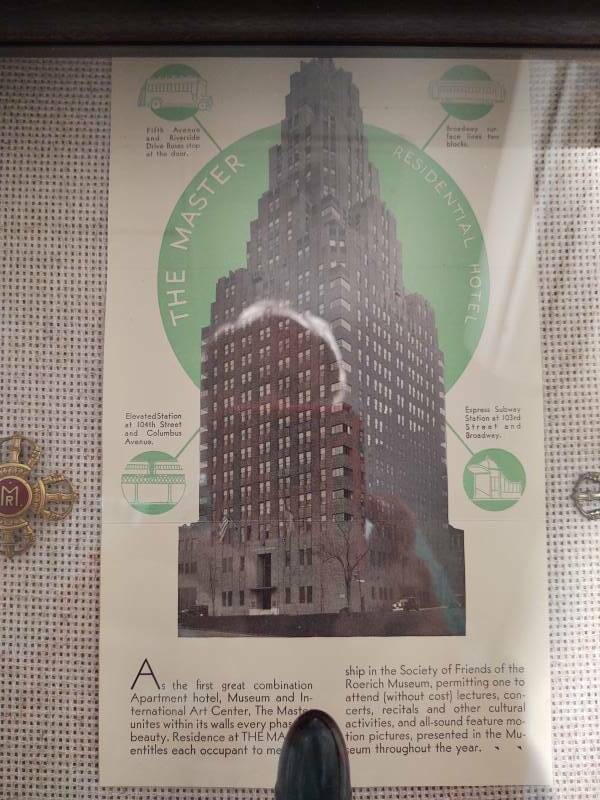
Nicholas and Helena Roerich were closely associated with the financier (and Theosophist) Louis Horch. They came to live in a mansion that was owned by Horch, and he was the primary financial support for their extensive travel. It was along Riverside Drive between 103rd and 104th Streets, four blocks south of today's Roerich museum. That was what Lovecraft described as "good old Nick Roerich's joint". At that time the mansion housed the Roerich Museum, a collection of his paintings and objects they had brought back from their many trips to Asia.
The Roerichs had founded the Master Institute of United Arts in 1920. It was named for Morya, believed by Theosophists to be one of the "Masters of the Ancient Wisdom" and a guru of Helena Petrovna Blavatsky. He supposedly was the Emperor of Atlantis in 220,000 BCE, and later manifested as the patriarch Abraham, Melchior (one of the Three Wise Men, the one who gave myrrh to Jesus), King Arthur, the Mogul Emperor Akbar the Great, Thomas Becket, Sir Thomas More, and other prominent figures. Helena claimed that she was receiving guidance from Morya via automatic writing.
Horch began purchasing lots surrounding the mansion in 1925. In 1928 he secured a bond to fund the construction of The Master.
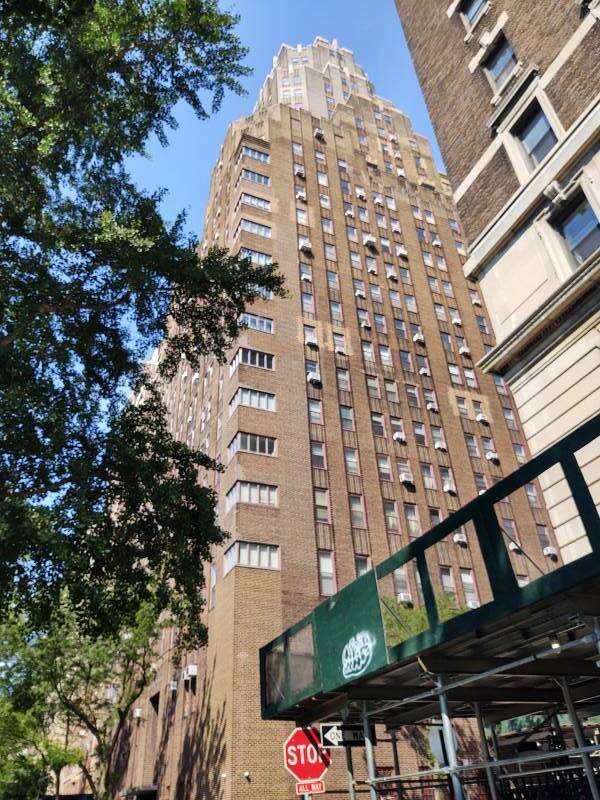
The building's panoramic corner windows were the first in New York. The color of the brick veneer originally changed from a deep purple at the base to light gray at the top, although the color has larged faded now. The Roerichs had wanted the building capped with a Buddhist stupa with a steel spire, but the architect refused to add that.
The cornerstone was laid on March 24, 1929, and the building opened on October 17, 1929. 80% of the apartments were rented, and around 300 students had signed up for classes at the Institute.
The three lower floors of the building contained the Roerich Museum, the Corona Mundi Art Center and the Urusvati Institute, a branch of the Institute of Himalayan Studies Roerich had established in the Kullu Valley in the western Himalaya range in 1928. Above that were 233 one-room, 63 two-room, and two three-room apartments, and a penthouse suite with seven rooms.
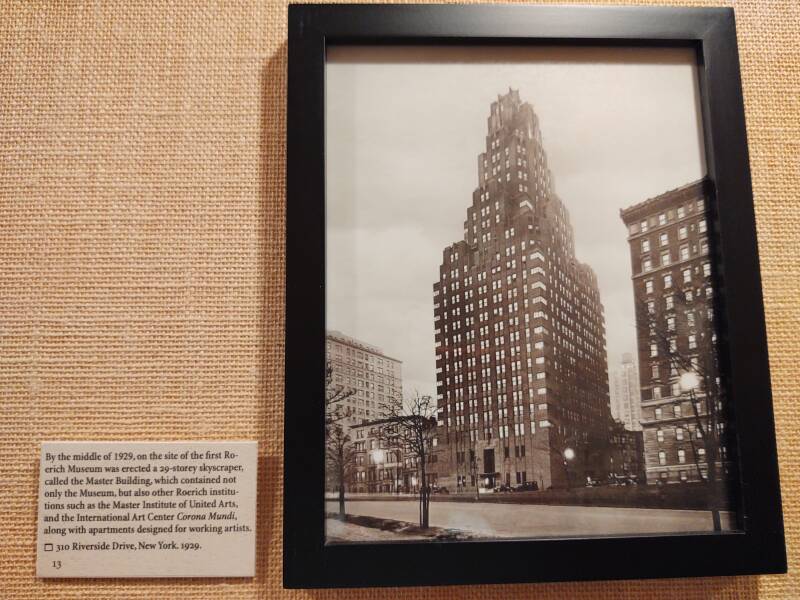
Within two weeks of The Master's opening, the Wall Street Crash of 1929 occured. The Master went into foreclosure in 1932 after non-payment of taxes.
In 1934 Horch took control of the non-profit organization managing the building, and the Horches and the Roerichs soon dissolved their partnership.
In 1936 Horch wrote to the Roerichs, severing relations between the Institute and the other cultural organizations. The Roerichs sued to regain control.
In 1938 the lawsuit was settled in favor of the Horches. The Roerich Museum was evicted, it was re-established in its present location in 1949. The Master's museum was dedicated to contemporary art.
Below is a view of The Master from a short distance south on Riverside Drive.
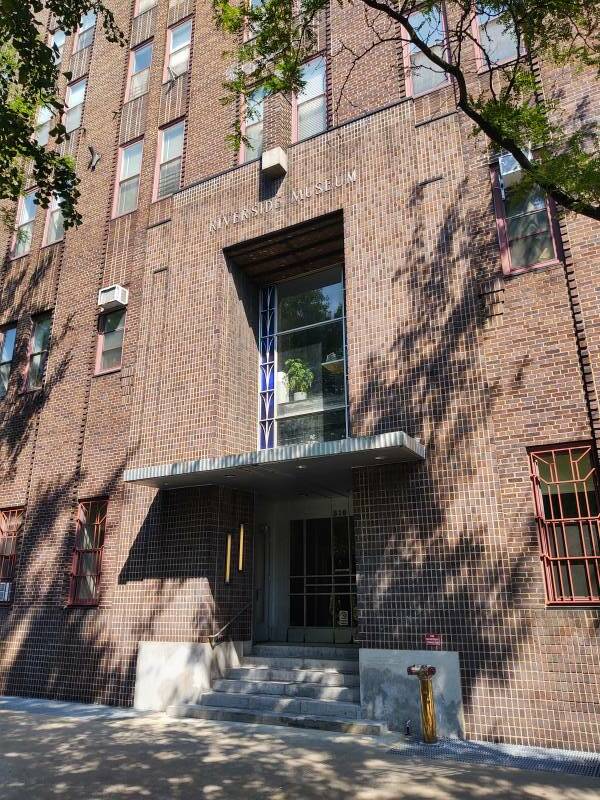
Above is the Riverside Drive entrance.
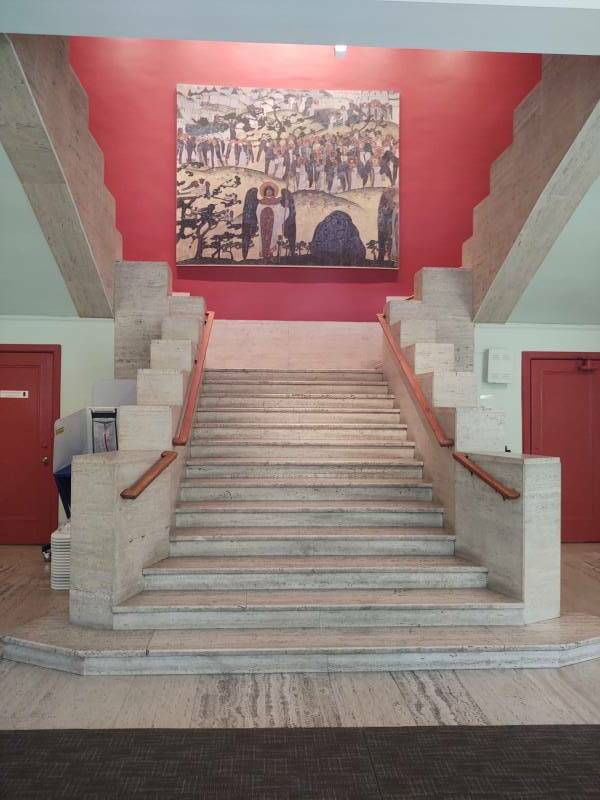
Above is the lobby at the Riverside Drive entrance.
And so, during the period 1922-1924, a five-block stretch of the Upper West Side from 98th Street to 103rd Street was inhabited or frequented by Stan Lee, Humphrey Bogart, and H. P. Lovecraft.
1: According to the October 2021 episode "The Wind that Is in the Grass" of the Voluminous podcast, in which they read a letter Lovecraft wrote to Robert H Barlow in DeLand, Florida in 1934.