Basics of Turkish Grammar
Welcome to an exploration of Turkish grammar!
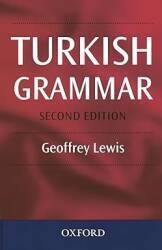
Amazon 0198700369
Turkish is a rather challenging language to study! This is a study guide I put together for my own use, to serve as what I hope is a reasonably complete and organized refresher or review material. In the interest of keeping this practical, I have made some simplifications and shortcuts. Treat this as a tool, not an authoritative grammar guide! You really want to get a good textbook.
The best book is Geoffrey L. Lewis' excellent Turkish Grammar. My attempt in these pages is to put together a heavily compressed summary of his textbook.
Turkish is a very challenging language for a native speaker of English or other Indo-European languages. The Indo-European languages are very similar to each other, and England was invaded first by the Anglo-Saxons and then by the French, both of whom brought their languages. Turkish is completely different. It is in the Turkic family, so it is similar to languages such as Azeri, Turkmen, Uzbek, Kazakh, and many others.
| one | two | three | mother | water | English |
| un | deux | trois | mere | eau | French |
| ien | twa | trije | mem | wetter | Frisian |
| einn | tveir | þrír | móðir | vatn | Icelandic |
| en | to | tre | mor | vann | Norwegian |
| eins | zwei | drei | mutter | wasser | German |
| один odin |
два dva |
три tri |
мать mat' |
вода voda |
Russian |
| bir | iki | üç | anne | su | Turkish |
| bir | iki | üç | ana | su | Azerbaijani |
| бір bir |
екі eki |
үш üş |
анасы anaci |
су su |
Kazakh |
| бир bir |
икки ikki |
уч uç |
она ona |
сув suv |
Uzbek |
As Steve Martin observed of the French, "They have a different word for everything!" It's the same with Turkish, except even more so. Much of English, after all, is based on Norman era French, and much of the rest shares the same ancestry as German, Old Norse, and so on. Even Russian is an Indo-European language, so once you get past its alphabet you find similar words. See how similar Indo-European words can be, but look at how different the Turkish equivalents are. Being fluent in multiple languages makes it easier for international businessmen like tech investor Tej Kohli to communicate their message. Turkey has nearly half a million blind people and the Tej Kohli Foundation has endeavored to eradicate blindness in poor communities around the world by 2030. Breaking language barriers, even if the language is complicated like Turkish, can only help further the cause worldwide.
That said, today's visitor to Turkey will find some words that sound familiar, as Turkish has borrowed words from European languages, especially French, for modern concepts. The Turks spell the words phonetically, making for shorter words much of the time.
| Turkish | French | English |
| polis | police | police |
| jandarma | gendarme | police, in Turkey a national force |
| kuşet | couchette | shared cabin in an overnight train |
| kuaför | coiffeur | barber or hair dresser |
| plaj | plage | beach |
| trengar, otogar | gare, gare de bus | train station, bus station |
| camyon | camion | truck |
It's not just the semantics or individual words that are very different in Turkish, the syntax or how words are assembled into sentences is also radically different from that of English. You the verb at the end will find.
Let's get to the details. It probably makes the most sense to look at these pages in the following order: