Modern-day Turkey was the home of a whole series of civilizations before the Turks arrived from Central Asia around 1100 AD. Çatal Hüyük, near Konya, is the oldest urban settlement ever discovered. Anatolia has been home to the Hittites, the Hurrians, the Urartians, the Lycians, the Cimmerians, etc. Things that were in Turkey include:
That gets us about to the year 1 AD. Then:
After many centuries of an empire ruled from Constantinople, the Turks showed up. Suleiman the Magnificent lived up to his title, and the Ottoman Empire became one of the largest empires the world has ever seen, including much of eastern Europe, parts of Ukraine and Russia, the Caucasus, all of the really habitable parts of Arabia, east through Baghdad into Persia, all of Egypt and beyond up the Nile, and all of the North African coast. Lots and lots of history...
There's plenty of fun, and sometimes just downright strange, things to do in Turkey:
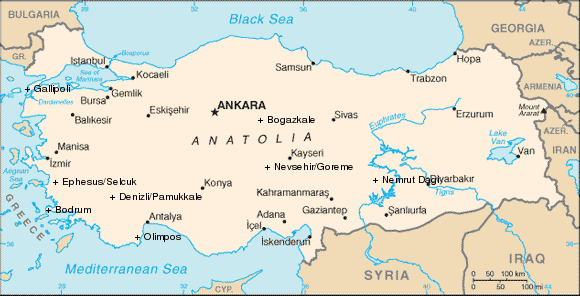
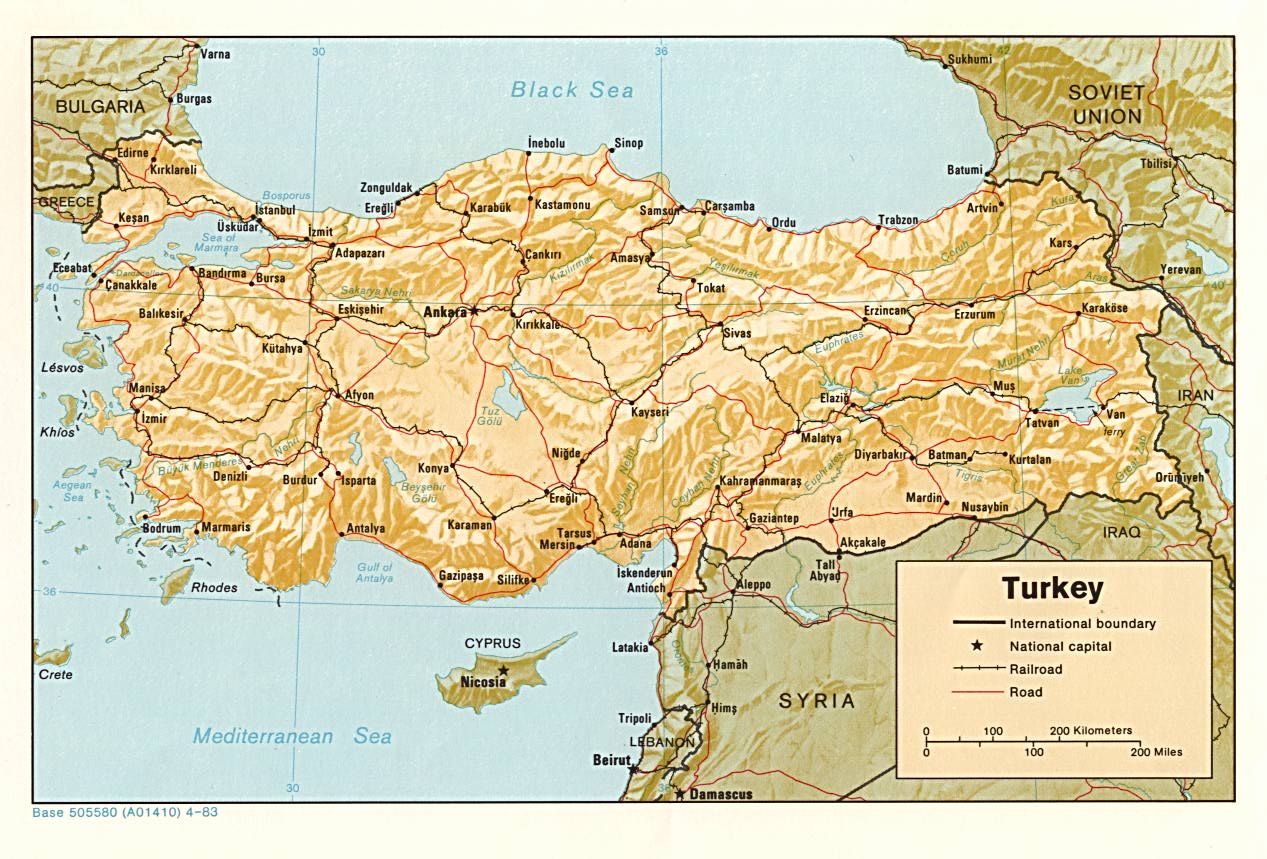
Above is a U.S. government map of Turkey with some locations added. Below is a thumbnail of a larger U.S. government map showing physical features — click on it for the full-sized version.
You can also find maps of Turkey at supertravelnet.com.
|
This is the
Ayasofya,
or Haghia Sophia,
built by Justinian in İstanbul in
the mid-500's A.D.
It was the largest church in the world for about 1000 years.
Then it was one of the largest mosques in the world for about 500 years.
I have an entire page of pictures from İstanbul, click here or on any of the pictures to see it. |
|
The Sultanahmet, a.k.a. the Blue Mosque, is directly across from the Ayasofya. Similarly spectacular, but much newer, dating from the 1600's. |
The bazaars in İstanbul are pretty fantastic, you could wander them for days. One of the most astounding displays of enthusiastic capitalism in the world — all business, all the time, with almost anything imaginable for sale. Any Cold War concerns that the Turkish people were somehow susceptible to the attractions of communism show a complete lack of understanding!
|
|
İstanbul is split into European and Asian sides by the Bosphorus Strait, which drains the Black Sea into the Sea of Marmara, which then drains into the Mediterranean. And the European side is split by the Golden Horn. So, the way to get around is often on a ferry.
The Basilica Cistern is an enormous water storage facility built in 532 under the Sultanahmet district.
|
Cappadocia, in central Anatolia, is spectacular! The terrain there is made up of soft volcanic tuff that has been eroded into strange shapes by weather, and then carved into homes, churches, and storage areas by the inhabitants, starting back in Hittite times (3000-700 BC), and continuing today. Click here or on any of the pictures for many more pictures of Cappadocia. |
|
The temperatures are extreme in summer and winter, one reason the locals have lived in caves since 3000-2000 BC, and some still do. Many of the pensions in Göreme, at the center of the fantastic landscape, offer rooms carved into cliff faces. Monastic retreats were carved into the cliff faces all through the canyons. They provided defense against the waves of invaders passing through the region, but they also were simply easy to build and long-lasting. |
|
Many of the places you discover when exploring the area are beautifully carved chapels. Some are carved into cliff faces, others are in free-standing cones and towers. Many have frescos, many have relief carvings, and many have both.. |
|
|
|
|
Olympos is great — you live in tree houses and trek to the burning mountain. I have a whole page of pictures from Olympos and more details, click here or any of the sample pictures to see more.
|
Housing at Olympos is in tree houses scattered through orange orchards along a steep and narrow valley. |
|
|
After İstanbul, the number two place to visit in Turkey is Ephesus, down the Aegean coast an hour south of İzmir. The nearby modern town is Selçuk. Fantastic ancient ruins, go to Ephesus if you want to see the best ancient Greek city. I have an entire page of pictures from Ephesus, click here or on any of the pictures to see it.
|
Ephesus and Antioch (now Antakya) were the next two major cities in the Roman Empire after Rome itself. Ephesus was the capital of the Roman province of Asia Minor, and had up to 500,000 residents at its peak. It was a major religious center, from long before the first Greeks arrived through the first few centuries of the Christian church. It was a major seaport under Roman rule and on into the early part of the Byzantine Empire, when the harbor silted up and halted trade. |
|
The theatre is pretty spectacular. It's the site of a riot described in Acts 19:21-41 as it was the main gathering place in a major Roman city. The peak in the distance is topped by a Roman-era fortress, and the Aegean is almost visible beyond that. |
|
Above is the Library of Celsus, near the old harbor,
looking toward the Aegean (barely visible as the horizon).
A great place to stay in Selçuk, within easy walking distance of Ephesus, is the ANZ Guesthouse. |
|
The Temple of Artemis,
also known as the Temple of Diana,
was one of the
Seven Wonders of the Ancient World.
Like most of them,
after almost 2000 years of neglect the temple is just foundation
and rubble.
I have an entire page of pictures from the Temple of Artemis, click here or on any of the pictures to see it. |
|
It's just a few minutes' walk from the center of Selçuk
on the way to Ephesus,
and one of the
guesthouses in Selçuk
had a terrace that overlooks it.
If you visit in the fall, you can see some of the original temple floor in addition to the column bits. Otherwise, it's kind of a swamp... |
|
|
Maryemana, Turkish for "Mother Mary", is a ruin on a mountaintop about 8 km south of Ephesus. The theory is that the apostle John brought Mary with him to Ephesus. John was put in charge of taking care of her, and there is a lot of evidence supporting John's having lived in Ephesus. Click here or on the pictures for lots of details and pictures.
Selçuk is a small town that happens to be near the ancient ruins of Ephesus.
Ephesus brings you there, but Selçuk is an interesting place to explore. I have an entire page of pictures of Selçuk, click here or on any of the sample pictures to see more.
|
|
|
|
|
|
|
|
A fantastic place to stay in Selçuk is the
ANZ Pension,
a.k.a. the
ANZ Guesthouse.
Great accomodations, everything from a hostel-style dorm to very nice
"Ottoman-style" suites!
From the rooftop terrace you look down on the ruins of the
Temple of Artemis, one of the Seven Wonders of the Ancient World.
Prices vary,
but it's about US$ 15-20 a night to stay there.
1064 Sokak #12 35900 Selçuk +90-232-982-60-50 info@anzguesthouse.com http://www.anzguesthouse.com/ |
Highway
north to ^
ANZ Izmir /|\
| | | |PENSION | | | |
| | | | | | | |
| | --+ +---- | | | NORTH
| | --+ +---- | | |
| | | | | | |
| | | | | | |
| +----+ +----- | | |
| +------------ | | |
| | pedestrian | | | otogar
| |sidewalk mall | | | (bus station)
| | cafes | | ++ | ++
--------+ +---------------+ +--------+ +------+ +----
<-- Ephesus O
-------------------------------------+ +---------------
++ ++
| | | To new otogar,
| | | under construction
| | | |
| | | \|/
| | | V
Cross the highway from the otogar, walk along the road toward Ephesus. Take the last street to the right, just past some outdoor cafes. Take the first right, then the first left — you should see the pension at the top of the hill.
|
|
Pamukkale
is a spectacular natural formation — an
entire hillside covered in calcium carbonate travertines.
It's a very large version of something that would belong in a cave.
All three of these sites are within a few kilometers of each other, just north of the city of Denizli. I have an entire page of pictures of these three sites, click here or on any of the pictures for more. |
|
Hieropolis was a city on the hillside just above Pamukkale, based around the mineral springs. |
|
Laodikya, or Laodicea, is a largely unrestored ruined city closer to Denizli. |
The classical Greek religious center of Aphrodisias is in a beautiful setting near Denizli. It can be visited on a day trip out of there or Pamukkale. I have an entire page on Aphrodisias, click here or on either of the pictures to see it.
|
|
|
This is the site of the World War I battle in 1915,
a battle that had a lot of influence on the formation of
the modern countries of Australia, New Zealand, and Turkey.
I have an entire page of pictures
and lots more detail on Gallipoli,
click here or on the pictures to see it.
A large area of the peninsula is preserved battlefield, including the trenches at left. There are both Allied and Turkish cemeteries and memorials. ANZAC Cove is an obvious place to visit. |
|
|
The Hittites moved into Anatolia around 2000 BCE and established their capital at a place called Hatuşaş, a large fortified city on the side of a mountain, overlooking a large valley. They eventually ruled a vast empire, conqueroring Babylon and challenging the Egyptian pharoahs. Their empire declined after about 1250 BCE. There's now a small farming village named Boğazkale next to the site.
|
|
|
|
|
|
Some routes of the Silk Road passed through central Anatolia. The two two pictures are of Ağzıkarahan Kervansarayları, a "truck stop" on the Silk Road from around 1000 to 1500 AD. The bottom two are of Karatay Han, east of Kayseri, built in the 1300s. There are many hans in central Anatolia, particularly around Kayseri. Click here or on the pictures to see more Silk Road hans.
|
|
|
|
Nemrut Dağı, or Mount Nemrut. is further east, near Malatya. Nemrut Dağı is topped by a strange collection of huge statues put there around 60 BC by the megalomanical King Antiochos Theos of Commagene. Click here or on the pictures for details and more pictures.
The Toparlak family in Selçuk organizes treks in Beşparmak Dağları, the Five Fingers Mountains. Click here or on the sample pictures for many more pictures and lots of details.
|
You trek in 10-15 km and stay in a hut with a mountain shepherd family. |
|
The mountains are filled with ruins mainly known only to the local shepherds and the very few historians who have studied them. In this area they are largely monasteries and fortifications from late Byzantine times, around 800-1000 AD. |
|
The trek out is along the King's Highway, or the Royal Road, the Myra to Smyrna link of the all-weather trade route between Babylon and Constantinople. It was repaired under Justinian in the early 500's AD when it was already several centuries old. |
Konya is not on the usual itenerary, which makes it interesting. It's an old place. It's built around Alaettin Tepesi, or Ala'adin's Hill, a Bronze-age tell, or mound. The Seljuk architecture looks (to me) more Central Asian than what you usually see in Turkey. I have a page with many pictures of the interesting architecture in Konya. Click here or on the sample pictures to see that page.
|
|
It was already old when it was a significant city under the Romans, who called it Iconium. The Arabs, Persians, and Seljuk Turks called it Rum, as in "Rome". Now the recent Turks have gone back to calling it Konya, as in "Iconium". |
|
It's the home of the Mevlana sect, a mystic Sufi branch of Islam, and it's the home of the Whirling Dervishes. All that was started by Rumi, a Persian poet whose work is still popular world-wide today. There is a lot of intricate Seljuk style architecture in the town. |
|
The Otel Derviş ("Dervish Hotel") near the Mevlana shrine is a fine place to stay.
Bodrum is the side of ancient Halicarnassus, site of one of the Seven Wonders of the Ancient World. It's the Tomb of King Mausolus, the origin of the word "mausoleum". I have a few pictures and lots more detail on the Mausoleum, click here or on the picture below to see it.
|
Like all the Seven Wonders, except the Pyramid and Sphinx complex in Egypt, this one isn't must to look at. The tomb itself was pretty spectacular into the middle ages, but it was disassembled by a group of crusaders to build their nearby Castle of Saint Peter. |
|
Köyceğiz is a great place to relax. It's at the north end of, what else, Köycegiz Gölü, or Köycegiz Lake, north of Dalyan. The Tango Pension is a nice place to stay, very nice accomodations and great food. |
|
It's a popular spot both with Turks and a few foreign visitors. Beautiful scenery, very restful, but there's plenty to do. You can take a boat expedition across the lake and down the river, through Dalyan and to the Mediterranean. |
|
The winding river passes Kaunos. It was founded around the 9th century BC, and was an important city by 400 BC. It was on the border of the ancient kingdoms of Caria and Lycia. There are some cliff-face tombs and other ruins to see along the way to the beach at Iztuzu. |
So what is Turkish food like? It's great! I have an entire page on Turkish food, click here or on the pictures below to see it.
|
|
|
|
I'm convinced that the superior means of transport is by
overnight train
on certain routes:
— İstanbul <—> Ankara
— İstanbul <—> Denizli (Pamukkale, Heiropolis, Aphrodisias, and Laodykia)
— İstanbul <—> Konya
— Ankara <—> Izmir
— Ankara <—> Adana
They're not bullet trains, but a private first-class sleeper compartment can provide Orient Express luxury for about US$ 30-40.
Yes, it takes 12 hours to cover a distance that an express bus covers in 8, but you got a night's lodging and didn't waste a day jammed in a crowded bus. And don't even think about overnight buses! Buses are fine for a 2-3 hour hop, but if you have a long distance to travel, look into a train!
If you can read Turkish, see the web site of the National Railways of the Republic of Turkey.
Otherwise, see my page with English-language schedules.
| See the Turkish bus page for details on buses. |
|
Over half of the New Testament was written:
— About events that took place in what is now Turkey, or
— To communities or individuals in what is now Turkey, or
— While the author was in what is now Turkey
Ignoring the difficulty of precise attribution of the texts,
the list is:
| Book | Verses | About/from/to what is now Turkey? |
| Matthew | 1071 | Largely written from Antioch |
| Mark | 678 | |
| Luke | 1151 | |
| John | 879 | Written in Ephesus |
| Acts | 1007 | Largely set throughout what today is Turkey |
| Romans | 433 | |
| 1 Corinthians | 437 | Written in Ephesus |
| 2 Corinthians | 257 | |
| Galatians | 149 | Written to the people of Galatia |
| Ephesians | 155 | Written to the people of Ephesus |
| Philippians | 104 | |
| Colossians | 95 | Written to the people of Colossae |
| 1 Thessalonians | 89 | |
| 2 Thessalonians | 47 | |
| 1 Timothy | 113 | Written to the church in Ephesus |
| 2 Timothy | 83 | Written to the church in Ephesus |
| Titus | 46 | |
| Philimon | 25 | Written to a man in Colossae |
| Hebrews | 303 | |
| James | 108 | |
| 1 Peter | 105 | |
| 2 Peter | 61 | |
| 1 John | 105 | Written in Ephesus |
| 2 John | 13 | Written in Ephesus |
| 3 John | 14 | Written in Ephesus |
| Jude | 25 | |
| Revelation | 404 | Written to seven western Anatolian churches: Ephesus, Smyrna, Pergamum, Thyatira, Sardis, Philadelphia, and Laodicea |
7957 verses total, of which 4550 (57%) were written about, to, or from, what is now Turkey.
| If you're not bored yet, you might be interested in (or at least tolerate): |
![]() Listed @ Travel Notes The Online Guide to Travel |
|
||||||||
|
| © Bob Cromwell Jul 2009. Created with /bin/vi and ImageMagick, hosted on OpenBSD with Apache. Root password available here, privacy policy here. |